If you have ever stood in an African shop in the UK, staring at a wall of flour bags with names like poundo, elubo, semovita, garri and fufu, the pounded yam vs semovita question is probably the first one that came to mind. They all end up as the same kind of thing on the plate: a soft, smooth ball of "swallow" that you pinch with your fingers and use to scoop up egusi, efo riro, ogbono or okra soup. But they are made from completely different crops, they taste different, they behave differently in the pot, and Nigerians have strong feelings about each of them.
This guide is for anyone cooking Nigerian food in a British kitchen: the student making their first pot of egusi away from home, the parent trying to keep the family's Sunday table the way it was in Lagos or Ibadan, and the curious friend who has been invited to a Nigerian house for dinner and wants to understand what is being served. We will go through what each swallow actually is, how it tastes, how to make it with nothing more than a saucepan and a wooden spoon, and which soups each one suits best.
What "swallow" actually means
In Nigerian English, "swallow" is the collective name for the soft, dough-like staples that are eaten with soup. The name comes from the way they are eaten: you pinch off a small piece, roll it gently in your fingers, make a small dent with your thumb, scoop up some soup, and swallow it rather than chewing it hard. In Ghana you will hear fufu and banku; in Sierra Leone, foofoo; across the region the idea is the same.
In the UK, almost nobody pounds fresh yam in a mortar any more. Space, noise and time all work against it. Instead, the swallows we eat here are made from dried flours and granules that you stir into boiling water on the hob. That is the key thing to understand: the real difference between pounded yam, semovita, amala and fufu in a British kitchen is the flour in the bag.
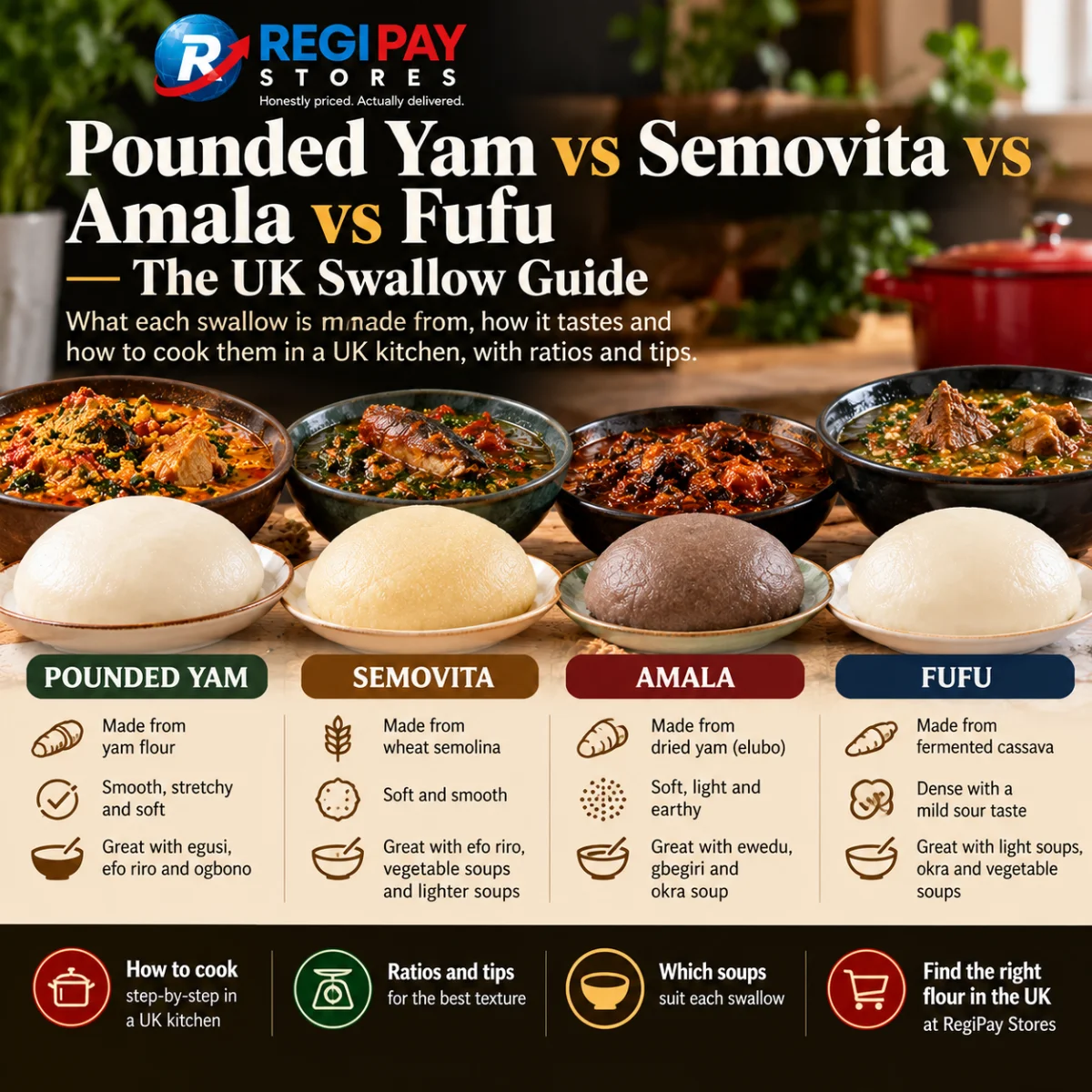
The four main swallows at a glance
| Swallow | Made from | Colour | Texture | Effort on the hob |
|---|---|---|---|---|
| Pounded yam (poundo / iyan) | Dried white yam, milled into flour | Bright white to cream | Smooth, stretchy, slightly elastic | Low to medium |
| Semovita | Wheat semolina (durum wheat) | Pale cream | Soft, smooth, less stretchy | Low |
| Amala (amala isu / elubo) | Dried yam, sun-dried and milled | Brown to dark grey-brown | Light, soft, slightly earthy | Medium (lumps form easily) |
| Fufu (akpu) | Fermented cassava | White to off-white | Dense, with a mild sour aroma | Medium |
| Eba (bonus) | Garri: fermented, roasted cassava granules | White or yellow | Firm, slightly grainy | Lowest |
Pounded yam
Traditional pounded yam is made by boiling chunks of white yam and pounding them in a wooden mortar until they turn into a smooth, stretchy dough. It is the swallow that most Yoruba households save for special occasions and Sunday lunches, partly because pounding fresh yam is hard work.
In the UK, the everyday version is made from pounded yam flour, often sold as poundo iyan or poundo yam. The flour is made from yam that has been processed and milled so that, when stirred into boiling water, it gives a texture close to the real thing. A good poundo should be smooth, with a slight stretch when you pull a piece apart, and it should not taste of anything other than mild yam. For a full step-by-step method, see our guide on how to make perfect pounded yam with poundo flour.
Pounded yam is the classic partner for egusi soup and efo riro. The stretch holds the thicker, oilier soups well, and the clean flavour lets the soup do the talking.
Semovita
Semovita is a brand name that has become the generic word for semolina swallow, a bit like "Hoover" in the UK. It is made from wheat semolina, so it is not a West African crop at all. It became popular in Nigeria because it is quick, consistent and widely available.
Semovita is smoother and softer than eba and does not have the fermented note that cassava swallows carry. Many people who are new to Nigerian food find it the easiest swallow to start with. Because it contains wheat, it is not suitable for anyone avoiding gluten, which is worth knowing if you are cooking for guests.
Amala
Amala is the brown swallow that is especially loved in the south-west, and particularly in Ibadan. Amala isu is made from yam that has been peeled (or sometimes left with the peel), sliced, sun-dried and then milled into a brown flour known as elubo. The drying gives it its colour and a slightly earthy, almost smoky flavour.
Amala is lighter and softer than pounded yam. It is the traditional partner for ewedu and gbegiri, often served together as "abula" with a ladle of stew on top. There are also amala made from plantain flour and from cassava flour (amala lafun), which are lighter in colour.
Amala is the trickiest of the flours to get right because it lumps easily. The trick, which we cover below, is to add the flour gradually and stir hard.
Fufu
In Nigeria, fufu (also called akpu, especially in the south-east) is made from cassava that has been soaked and fermented, then cooked and pounded or stirred into a dense dough. It has a gentle sour smell that people either love or need to get used to. In the UK you will find both fufu flour and ready-made fufu, and some brands sold as "fufu" in UK shops are actually made from plantain or a blend of starches, so read the ingredients list on the back.
Fufu is heavier than pounded yam and is very filling. It pairs beautifully with ogbono, okra and bitterleaf (ofe onugbu) soups.
And eba, the everyday favourite
No swallow guide is complete without eba. Eba is made from garri, which is cassava that has been grated, fermented, pressed and then roasted into dry granules. You pour boiling water over garri and stir, and in a couple of minutes you have eba. Yellow garri has palm oil added during processing; white garri does not. Ijebu garri, from Ogun State, is finer, more sour and is the one most people prefer for soaking and drinking with cold water and sugar. We explain why in Ijebu garri explained.
Pounded yam vs semovita: which should you choose?
If you are deciding between the two, it comes down to taste, texture and who you are cooking for.
- Choose pounded yam if you want the closest thing to a traditional Nigerian Sunday meal, especially with egusi or efo riro. It has more body and stretch, and it is what most Yoruba relatives will expect.
- Choose semovita if you want something quick, mild and very forgiving to cook. It is a good everyday swallow and a gentle introduction for children or friends who are new to Nigerian food.
- Avoid semovita if anyone at the table is avoiding gluten. Pounded yam, amala, fufu and eba are all made from yam or cassava rather than wheat, although you should always check the label for any blends.
How to cook each swallow in a UK kitchen
You do not need special equipment. A medium, heavy-based saucepan, a kettle and a sturdy wooden spoon (Nigerians call it a "turning stick" or omorogun) are enough. A flat wooden spatula also works well.
Pounded yam from flour
- Boil about 500ml of water in the kettle and pour it into your saucepan over a medium heat.
- Sprinkle in the flour a handful at a time, stirring hard. As a rough guide, start with about two parts flour to three parts water by volume and adjust as you go.
- When it thickens, press and fold the dough against the side of the pan for a minute or two. This is where the smoothness comes from.
- Make a small well in the middle, add two or three tablespoons of hot water, cover and leave on a low heat for two to three minutes.
- Stir again until smooth and stretchy, then wrap in cling film or scoop into balls.
Semovita
- Bring about 500ml of water to the boil in a saucepan.
- Pour in the semolina gradually while stirring continuously so that it does not form lumps.
- Once it starts to thicken, keep stirring and folding for two to three minutes.
- Add a splash of hot water, cover, steam for two minutes, then give a final stir.
Amala
- Boil the water in a saucepan, then turn the heat down to medium.
- Add the elubo in small amounts and stir very fast. If you dump all the flour in at once, you will get lumps that refuse to break up.
- Once it has come together, add a little hot water, cover and steam for about three minutes.
- Stir again firmly until smooth. Amala should be soft and light rather than stiff.
Fufu from flour
- Mix the flour with a little cold water first to make a smooth paste, then add it to a pan of hot water.
- Cook on a medium heat, stirring and folding for several minutes until the dough becomes stretchy and slightly translucent.
- Steam, covered, for a couple of minutes, then stir again.
Eba from garri
- Boil the kettle and pour about 300ml of water into a bowl.
- Sprinkle the garri evenly over the surface until the water is just covered.
- Leave it for a minute to absorb, then stir firmly with a wooden spoon, folding it into a smooth ball. Add more garri if it is too soft, or a splash of hot water if it is too hard.
Practical tips for UK kitchens
- Electric and induction hobs heat unevenly. Use a heavy-based pan and keep the heat on medium. A thin pan on a high setting will scorch the bottom of amala and fufu.
- The microwave works in a pinch. For pounded yam and semovita, you can mix flour and boiling water in a microwave-safe bowl, cook for one to two minutes, stir, then cook again for a minute. It is not traditional, but it is useful in a student flat.
- Store flour away from damp. British kitchens, especially in winter, can be humid. Decant opened bags into airtight tubs and keep them in a cupboard away from the kettle and cooker.
- Wrap and keep warm. Wrap portions in cling film or foil and keep them in a covered dish so they do not form a skin before you serve.
- Leftovers. Wrapped swallow keeps in the fridge for a day. Reheat with a splash of water in the microwave, covered, and knead briefly with a spoon.
Which soup goes with which swallow?
There are no strict rules, and every family has its own habits, but these pairings are the ones you will see most often:
- Egusi soup: pounded yam, eba or semovita
- Efo riro: pounded yam or amala
- Ewedu and gbegiri: amala, served with stew
- Ogbono: fufu, eba or semovita
- Okra soup: fufu, eba or amala
- Bitterleaf soup (ofe onugbu): fufu or pounded yam
- Banga soup: starch in the Niger Delta, or eba and pounded yam elsewhere (see our banga soup recipe)
Common mistakes to avoid
- Adding all the flour at once. This is the number one cause of lumpy swallow, especially with amala.
- Skipping the steam. That short covered rest with a splash of hot water is what turns a stiff dough into a smooth one.
- Using a whisk. It traps air and leaves you with a gluey mess. Use a wooden spoon and fold.
- Making it too hard. Swallow should be soft enough to pinch easily. If you need to chew it hard, add more hot water next time.
Where to find these in the UK
Once you know which swallow you like, the next step is keeping it in the cupboard so that a proper Nigerian meal is never more than fifteen minutes away. At RegiPay Stores we stock the swallow flours that come up most often in Nigerian kitchens across the UK.
If pounded yam is your swallow, the Africa King Pounded Iyan and the Olu Olu Poundo Iyan 4kg are both reliable choices for a smooth, stretchy result. If your household eats a mix of eba and pounded yam, the Ijebu Garri and Poundo Essentials bundle puts both in one order. And if you are stocking a whole kitchen from scratch, the West African Pantry Starter brings swallow, palm oil and noodles together so your next pot of egusi has everything it needs.