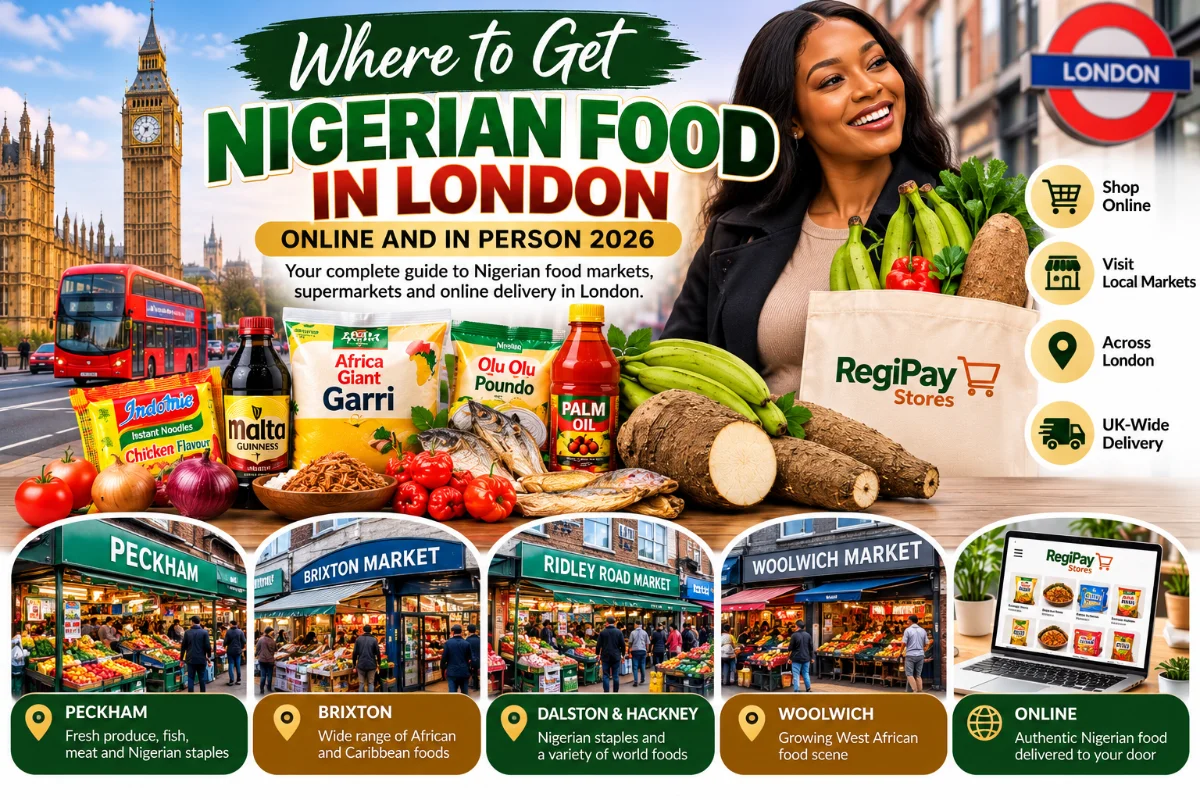
London is home to one of the largest Nigerian communities anywhere outside Nigeria. Generations of Nigerian families have settled across the capital, and their food has followed them. Today you can find egusi, suya spice and fresh yam in markets, high-street shops and online stores across the city, and Nigerian restaurants and caterers are part of everyday London life.
If you have just moved to London, are cooking Nigerian food for the first time, or simply want to know where people actually shop, this guide walks through the main options: the markets, the independent Nigerian and West African supermarkets, online delivery, and what to think about when you are buying for events or for Christmas.
Nigerian food markets in London
Peckham
Peckham in south-east London is often described as the heart of Nigerian food in London, and with good reason. Rye Lane and the streets around it are lined with African grocers, butchers, fishmongers and hair and beauty shops. You will find fresh yam, plantain, peppers, scotch bonnets, smoked and dried fish, stockfish, goat meat, palm oil, garri, egusi and ogbono, often from several shops within a few minutes' walk of each other.
Peckham is also a good place to pick up more specialist items, such as ogiri, iru (locust beans), uziza and utazi leaves, and the dried leaves and spices used in particular regional soups. Saturdays are busy, so go early if you want the best choice of fresh produce.
Brixton Market
Brixton Market and the surrounding streets are best known for Caribbean food, but West African products are widely available too. Expect a strong selection of fresh fruit and vegetables, including plantain, yams, sweet potatoes, scotch bonnets and callaloo, alongside fishmongers, butchers and grocers selling West African dry goods. Brixton is a good choice if your household cooks across both Nigerian and Caribbean traditions.
Dalston and Hackney
In east London, Ridley Road Market in Dalston and the shops around Hackney have long served African, Caribbean and Turkish communities. You will find both East African and West African grocers, with plantain, yam, cassava, peppers, dried fish and spices. The mix of cultures means you can pick up Nigerian staples and a wide range of other world foods in a single trip.
Woolwich
Woolwich, in south-east London, has a growing West African food scene. Powis Street and the streets around Woolwich market have a number of African grocers and butchers, and the area is well known for Nigerian restaurants and caterers. It is a convenient option for families across Greenwich, Thamesmead, Plumstead and Abbey Wood.
What you can find at each market
Across all of these areas you can usually expect fresh yam and plantain, peppers and scotch bonnets, onions, tomatoes, fresh and frozen meat and fish, dried fish and stockfish, garri, poundo, rice, beans, palm oil and the main Nigerian soup ingredients. The difference is mostly in emphasis: Peckham is strongest for specialist Nigerian items, Brixton for Caribbean produce, Dalston and Hackney for variety, and Woolwich for a growing local West African community.
Nigerian supermarkets in London
Beyond the markets, London has a large number of independent West African supermarkets, from small corner shops to large stores with their own butcher's counters and frozen sections. They are spread across boroughs including Southwark, Lewisham, Lambeth, Greenwich, Croydon, Barking and Dagenham, Enfield and Hackney.
What they typically stock
- Fresh yam — usually puna yam from Ghana or Nigeria, sold by the tuber.
- Stockfish — whole or cut pieces of dried cod, essential for many soups.
- Ogiri — a fermented seasoning with a strong aroma, used in soups such as egusi and ewedu.
- Dried crayfish — whole or ground, for depth of flavour.
- Suya spice — also called yaji, a blend of ground peanuts, chilli and spices for grilled meat.
- Garri, poundo, semovita, elubo, rice, beans, palm oil, egusi, ogbono, seasoning cubes, Nigerian biscuits and snacks, and malt drinks.
Advantages of shopping in person
Shopping in person has real benefits. You can check the freshness of yam, plantain and peppers for yourself, which matters a great deal for produce that does not travel well. You can see the full variety on the shelves, ask the shopkeeper for advice, and often find regional ingredients that are hard to source online. For many shoppers, buying in person is also the easiest way to compare value and choose the size and quality you want.
Nigerian food delivery in London
Not everyone lives near Peckham or has time to spend a Saturday morning on Rye Lane. That is where online Nigerian food retailers come in. A number of UK-based online stores deliver Nigerian groceries to addresses across London.
Benefits of ordering online
- Convenience — no travel, no carrying heavy bags of garri and cases of drinks on the bus or Tube.
- Bulk buying — online stores often sell larger pack sizes, multipacks and full cartons, which suits families and anyone who cooks Nigerian food regularly.
- Door-to-door delivery — useful for heavy items such as palm oil, rice and drinks, and for anyone with limited mobility or a busy schedule.
Online shopping works best for dry and tinned goods: garri, poundo, rice, beans, noodles, palm oil, seasoning, drinks and snacks. Fresh produce such as yam, plantain and peppers is often better bought locally.
What to look for in an online Nigerian food retailer
Before you order from a store you have not used before, check that the seller is based in the UK and lists contact details. Product pages should show the brand, size and quantity clearly, and food listings should include ingredients and allergen information. Look for a published delivery policy with realistic timescales, a clear returns policy, and independent customer reviews.
Nigerian food for events in London
Nigerian celebrations are famous for their food, and London hosts a huge number of them every weekend. Naming ceremonies, birthdays, weddings, graduations, thanksgiving services and anniversaries all call for food in quantity.
Bulk supplies for catering
If you are cooking for a large group, it is worth planning your dry goods well in advance. The essentials usually include:
- Rice — long-grain parboiled rice in large sacks for jollof and fried rice.
- Palm oil — in larger bottles or containers for stews and soups.
- Indomie — full cartons are handy for younger guests and for feeding helpers on the day.
- Seasoning, tomato paste, onions and peppers — the base of almost every party dish.
Chafing dishes for large events
Keeping food warm is one of the biggest practical challenges at a Nigerian party, especially in halls where the food is cooked off-site. Chafing dishes, which hold food over a gentle heat source, are widely used at Nigerian events in London. Many families now own a set rather than hiring them for each occasion.
Malta Guinness for Nigerian parties
No Nigerian party is complete without drinks, and Malta Guinness is a staple. It is non-alcoholic, which makes it suitable for children and for guests who do not drink. Buying full cases rather than individual cans or bottles makes it easier to cater for a crowd. Supermalt, soft drinks and Chapman are other popular choices.
Nigerian Christmas food in London
Christmas is one of the biggest celebrations in the Nigerian calendar, and Nigerian households in London mark it with a spread that looks quite different from a traditional British roast.
What Nigerians eat at Christmas
- Jollof rice — the centrepiece of almost every Nigerian Christmas table.
- Fried rice — Nigerian-style, with mixed vegetables and often liver or prawns.
- Puff puff — soft, sweet fried dough balls.
- Chin chin — crunchy fried dough snacks, often made in big batches and shared with visitors.
- Suya — spiced, grilled skewered meat.
- Goat meat pepper soup — a peppery, aromatic broth that is a favourite starter.
Fried plantain, moi moi, chicken and small chops also feature in many homes.
Where to get Nigerian Christmas food ingredients in London
The markets and West African supermarkets listed above get extremely busy in the weeks before Christmas, particularly in Peckham, Woolwich and Brixton. Goat meat in particular can be in high demand, so many families order from their butcher in advance. Buying dry goods such as rice, palm oil, flour for puff puff and chin chin, seasonings and drinks early, whether in person or online, lets you focus on fresh ingredients in the final days.
Finding what works for you
London gives Nigerian food lovers more choice than almost anywhere outside Nigeria. Markets and independent supermarkets are best for fresh produce and specialist ingredients, while online retailers are ideal for bulk dry goods, drinks and anything heavy. Most households end up using a mix of both, depending on the occasion.
You can browse our range of African and Caribbean groceries, including Nigerian staples, swallows and malt drinks.