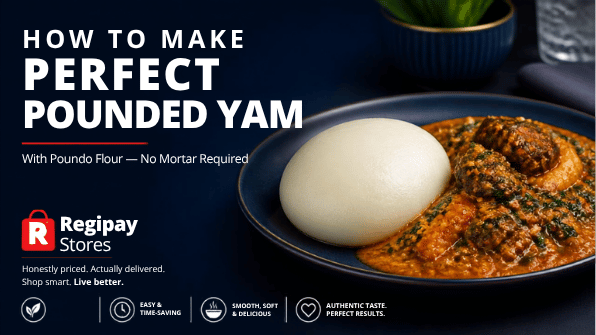
Pounded yam made with poundo flour takes about eight minutes and needs nothing more than a saucepan, a wooden spoon and boiling water. No mortar, no pestle, no waking the neighbours. The trick is not the flour — it is the ratio, the heat and the way you work the dough in the first ninety seconds.
This guide covers the method that works reliably in a UK kitchen, the mistakes that produce lumpy or sticky results, and how to reheat leftovers so they behave like fresh.
Last reviewed August 2026. Prices, pack sizes and availability change — confirm the current price on the product page before ordering.
What poundo flour actually is
Poundo iyan is dried, milled yam. Real yam — usually white puna yam — is peeled, dried and ground into a fine, pale flour. When you add boiling water and work it, the starch gelatinises and reassembles into the smooth, stretchy swallow you would otherwise spend twenty minutes pounding by hand.
It is not the same thing as instant fufu (cassava), semolina, or plantain flour. Those are all good in their own right, but they taste different and they behave differently under the spoon. If a recipe calls for pounded yam and you use cassava fufu, you will notice.
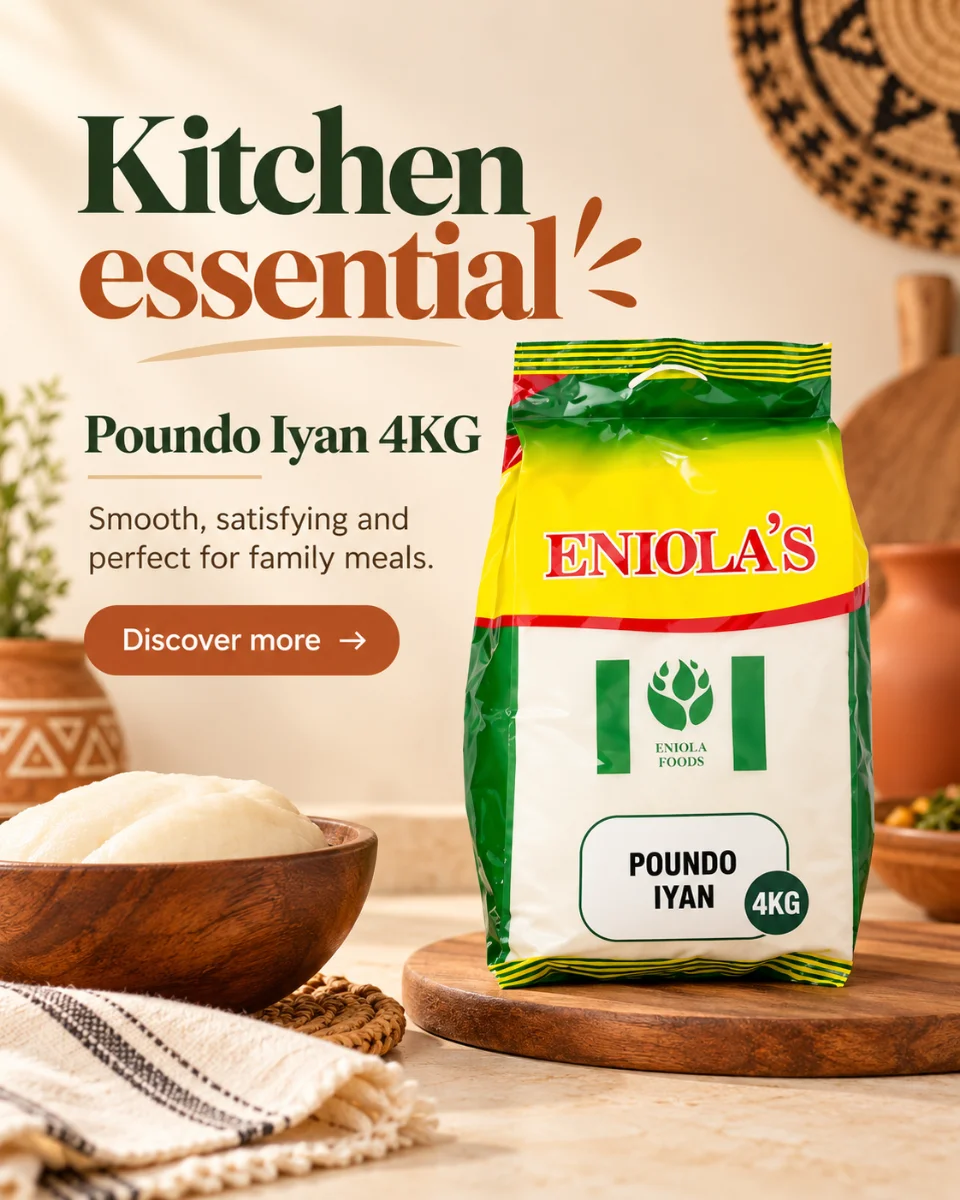
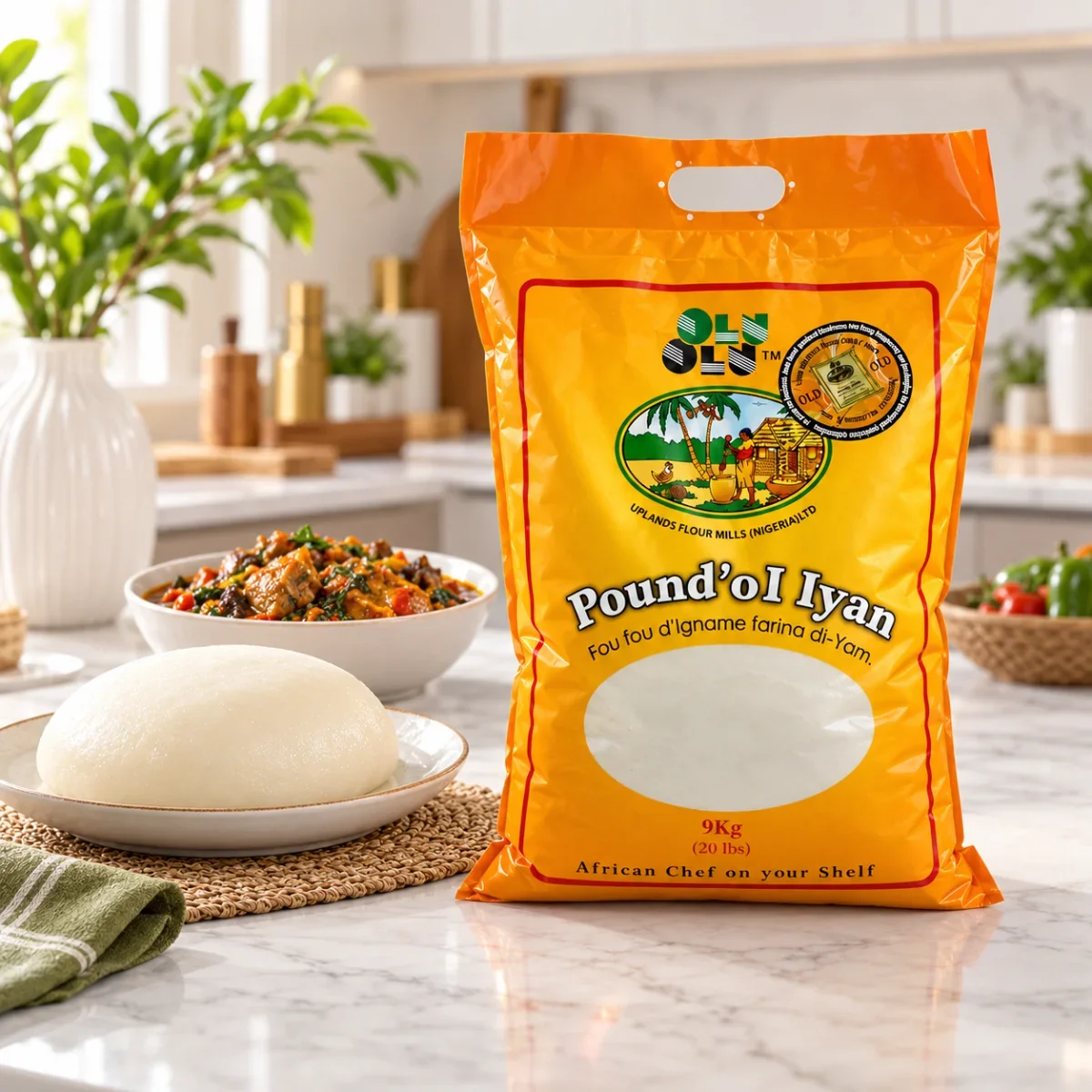
Quality varies a lot between brands. Cheaper flours are cut with cassava or maize, which is why some tubs go grey, taste flat or turn gluey. A pure yam flour like the Olu Olu Poundo Iyan 4kg stays cream-white and holds its shape on the plate — worth knowing if you have been disappointed by a supermarket tub before.
What you need
- A heavy-based saucepan (thin pans scorch the bottom of the dough)
- A sturdy wooden spoon or a proper omorogun turning stick
- A kettle
- A bowl of cold water for shaping
- Cling film or a small bowl to mould the finished swallow
That is genuinely it. You do not need a food processor, and a stand mixer is more trouble than it is worth for a single portion.
The ratio
This is where most people go wrong. The packet instructions are usually vague, and yam flour absorbs far more water than it looks like it should.
| Portions | Poundo flour | Boiling water |
|---|---|---|
| 1 generous | 100 g (about 200 ml by volume) | 250 ml |
| 2 | 200 g | 500 ml |
| 4 | 400 g | 950 ml |
| 6 | 600 g | 1.4 litres |
Hold back roughly a fifth of the water at the start. It is easy to add more; it is a nuisance to fix a dough that has gone soupy.
The method, step by step
- Boil the water. Properly boiling, not hot from the tap and not simmering. Yam flour needs the heat to cook out, and lukewarm water is the single most common cause of a raw, chalky taste.
- Pour about four fifths of the water into the saucepan and keep it on a low heat.
- Add the flour all at once, in the centre. Do not sprinkle it in gradually — that is how you get lumps. Tip it in as one mound and let it sit for about twenty seconds while the water soaks up through it.
- Start turning. Press the spoon down through the middle of the mound and fold outwards, working from the centre to the edge. Keep the heat low. For the first minute it will look wrong: sticky, patchy, lumpy. Keep going.
- Work it for four to five minutes. This is the actual work. The dough will pull away from the sides of the pan and start to look glossy and elastic. Add a splash of the reserved water if it feels too stiff to turn.
- Cover and steam for two minutes on the lowest heat. This finishes cooking the centre and is the step people skip.
- Turn once more, then shape.
To shape, wet a small bowl or a sheet of cling film with cold water, drop in a portion, and swirl it into a smooth round. Cold water is what stops it sticking to everything.
How to tell when it is done
Fresh, correctly cooked pounded yam is:
- Smooth — no visible grains or dry pockets
- Stretchy — a pinch pulled from the mass should stretch a couple of centimetres before breaking
- Glossy, not matte or floury-looking
- Neutral-sweet in taste, with no chalky, raw-flour aftertaste
If it tastes raw, it needs more heat and more turning, not more water.
Fixing the four common problems
It is lumpy
The flour went in too slowly, or the water was not hot enough. Fix it by pressing the lumps against the side of the pan with the back of the spoon while turning, and add a tablespoon of boiling water at a time. Prevention is easier than the cure: all the flour, all at once, into properly boiling water.
It is too soft and will not hold its shape
Too much water. Keep it on a low heat and keep turning with the lid off — you are evaporating the excess. Give it three or four minutes. Do not add dry flour to a wet dough; you will get lumps that never break down.
It is too stiff
Add boiling water a splash at a time and work it in fully before judging. Cold water added at this stage cools the dough and makes it gluey.
It has gone grey or tastes off
That is usually the flour, not you. Yam flour absorbs moisture and odours from the cupboard. Keep it sealed, dry and away from onions and spices, and buy a size you will actually get through — a 4 kg bag is good value for a household that eats swallow weekly, less so if it is once a month.
What to serve it with
Pounded yam is a vehicle. The soup is the point. The classics:
- Egusi — melon seed, thick and rich, the most popular pairing
- Efo riro — spinach-based, lighter, quick on a weeknight
- Ogbono — draw soup, glossy and slippery
- Banga — palm fruit, deep and aromatic, best made with proper red palm oil
- Okra — fast, fresh, forgiving
The eating convention matters too: pinch a small piece with your right hand, roll it into a ball, press a dip into it with your thumb, scoop, and swallow without chewing. Chewing pounded yam is not wrong, it is just not the point.
Storing and reheating
Fresh is best, but leftovers keep well if you handle them right.
- Fridge: wrap tightly in cling film while still warm and refrigerate for up to three days. It will firm up considerably.
- Freezer: wrap in cling film, then foil, and freeze for up to a month. Defrost in the fridge overnight.
- Reheating: microwave in thirty-second bursts with a damp piece of kitchen roll over the top, turning between bursts. Or steam it for five minutes over a pan of simmering water, which is slower but gives the better texture.
Never reheat it dry. Yam flour that dries out goes hard and grainy and cannot be brought back.
Making it for a crowd
Scaling up is mostly about arm strength and pan size. Above about six portions, split it across two pans — one large batch in a single pan cooks unevenly and is genuinely hard to turn. Make it last, just before serving, and keep the portions wrapped and warm rather than trying to hold one big mass.
If you are cooking for a party, do the soup the day before. Soup improves overnight. Swallow does not.
Frequently asked questions
Is poundo yam the same as fufu?
No. Poundo yam is made from dried yam; fufu is usually made from fermented cassava. Fufu has a slightly sour note and a softer, stickier texture. Both are swallows, but they taste noticeably different and are not straight substitutes.
Can I make pounded yam in the microwave?
You can, and it works reasonably well for one portion. Mix flour and boiling water in a microwave-safe bowl, cover, and microwave in one-minute bursts, stirring hard between each, for three to four minutes total. The texture is slightly less elastic than the pan method but it is fine on a weeknight.
Why does my pounded yam taste chalky?
Almost always undercooking. The starch has not fully gelatinised. Return it to a low heat, add a splash of boiling water, and keep turning for another two or three minutes with a lid-on rest at the end.
How much poundo flour do I need per person?
Around 100 g of flour per adult portion, which yields a generous fist-sized mound. Teenagers and anyone who has been at work all day will happily eat 150 g.
Is pounded yam gluten free?
Pure yam flour contains no gluten. Check the packet, though — some cheaper blends include wheat or are milled in facilities that handle it, and the label will say so.
How long does a 4 kg bag last?
Roughly forty adult portions. For a household of four eating swallow once a week, that is around ten weeks. Keep it sealed and dry and it will hold its quality for the whole run.
Getting the ingredients
Good pounded yam starts with good flour, and the gap between a pure yam flour and a cheap blend is obvious from the first spoonful. You will find yam flour, garri, palm oil and the rest of the store cupboard in our African and Caribbean groceries range, sized for households that cook this food properly and often.