If you have spent any time in a UK hair shop, a Nigerian WhatsApp group or the comments under a wig install video, you will have heard the same question come up again and again: Burmese or Brazilian? Both are sold as premium human hair, both promise softness and long wear, and both sit side by side on every supplier's list. Yet they behave very differently once they are on your head, and choosing the wrong one for your natural texture is the quickest way to end up with a style that never quite blends.
This guide looks at Burmese hair UK buyers are increasingly asking for, explains where it comes from and why it has become such a favourite in the Nigerian and wider West African community here, and then puts it head to head with Brazilian hair. We will also cover how to care for Burmese human hair bundles so they last, how to pick the right length for the occasion, and what to check before you buy from any supplier.
Introduction: why everyone is talking about Burmese hair
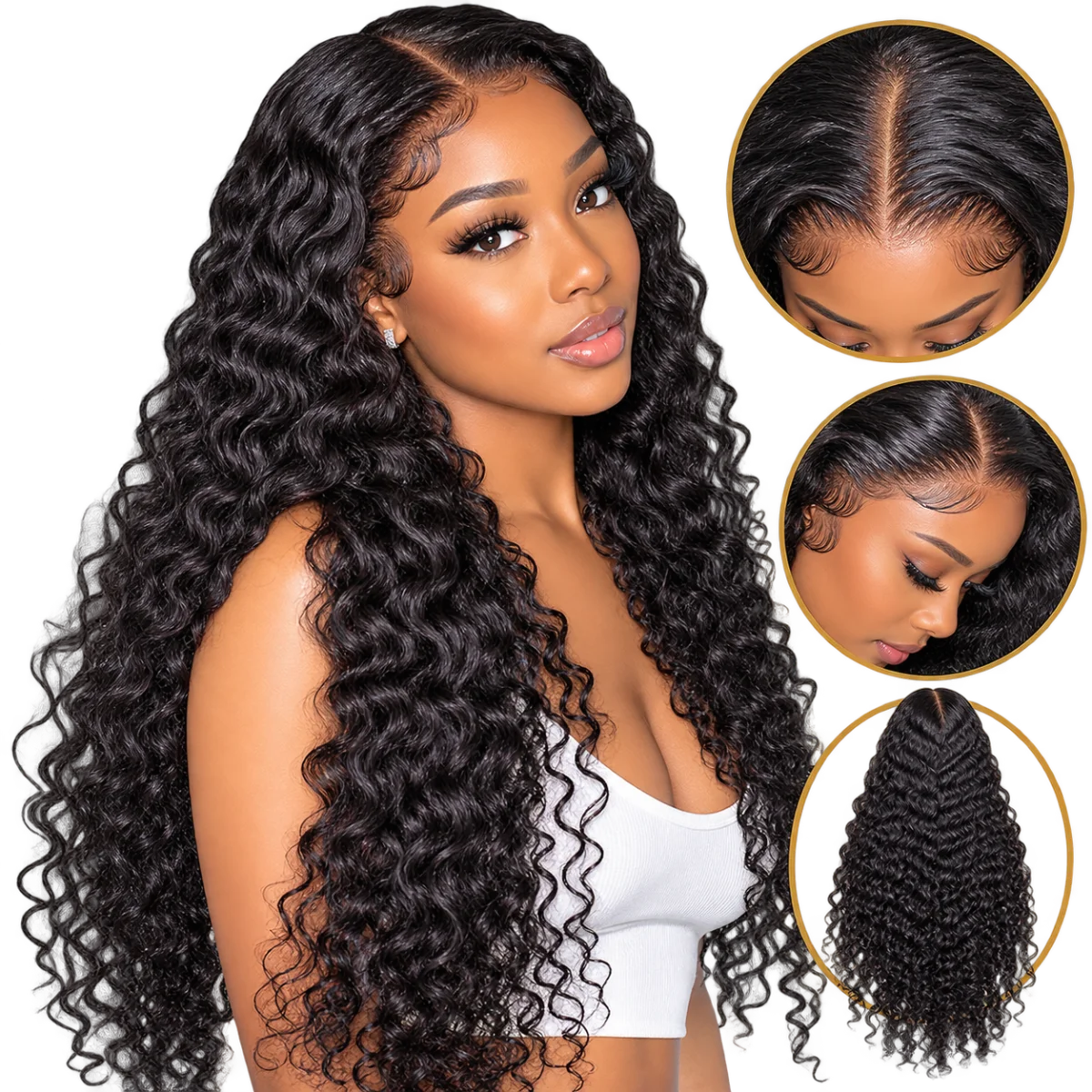
Burmese hair is human hair marketed as originating from Myanmar (formerly Burma) in South East Asia. In the extensions trade it has built a reputation for one thing above all: curl. Where many hair types are sold straight or with a loose body wave, Burmese hair is best known in its curly and coily forms, with a tighter pattern that sits much closer to the hair many African and Caribbean women grow naturally.
That is exactly why it has taken off in the UK. Over the past few years more Nigerian, Ghanaian and wider West African women have moved towards wearing their natural texture, or at least towards protective styles that look like it. Twist-outs, wash-and-gos and big defined curls have replaced the bone-straight look that dominated for so long. When you want extensions that look like a fuller, longer version of your own hair, rather than something obviously added, a curly hair type is the natural place to start. Burmese hair fits that brief.
There is also a cultural element. In Lagos, Abuja and Accra, Burmese curls have been a status hair type for years, and that preference has travelled with the diaspora to London, Manchester, Birmingham and beyond. Ask around at a UK owambe and you will find plenty of women who first heard about Burmese hair from a sister or aunty back home.
Section 1: What is Burmese hair?
Origin: Myanmar
Burmese hair is sold as being sourced from donors in Myanmar. It is worth knowing that country-of-origin names in the hair industry are often used as trade labels as much as strict geographic guarantees. "Burmese", "Brazilian", "Peruvian" and "Malaysian" frequently describe a texture and grade as much as a place. A good supplier should still be able to tell you where their hair is collected and processed, and that transparency is one of the things to look for (more on that later).
Texture characteristics
Genuine Burmese hair is known for being soft yet dense, with a slightly coarser strand than very fine hair types. That extra body is part of its appeal. It does not go limp or lie flat after a few washes, and it holds a defined curl without needing much product.
Natural curl pattern: 3C to 4A
The curly Burmese hair most UK buyers want usually sits in the 3C to 4A range on the common hair-typing chart:
- 3C curls are tight corkscrews, roughly the width of a pencil or straw, packed closely together.
- 4A is the start of coily hair, with small, springy S-shaped coils that are clearly defined when moisturised.
This is the key difference between Burmese and many other hair types. Instead of having to perm, rod-set or wand-curl straight hair to get close to your natural pattern, curly Burmese bundles already arrive at a texture that can sit alongside 3C to 4B leave-out with very little work.
Thickness and lustre
Burmese hair tends to have a medium to low natural lustre. It does not have the glassy shine of heavily processed hair, which is a good thing if you want it to blend with natural African hair, as Afro-textured hair naturally reflects less light. The strands are full from root to tip on good quality double-drawn bundles, so the ends do not look thin or wispy.
How it compares to natural African hair textures
No extension will perfectly copy Type 4 hair, because tightly coiled hair has a unique zig-zag structure and very low shine. However, Burmese curls get closer than most. With a little curl cream and a gentle finger-coil, 3C to 4A Burmese hair can blend with 4A and 4B leave-out convincingly. For women with 4C hair, it often works best in closure or frontal units, or with leave-out that has been lightly stretched.
Why Nigerian women prefer it
Nigerian women in the UK tend to give the same reasons when they explain their preference for Burmese hair:
- It looks like "our" hair. The texture reads as natural rather than borrowed.
- It is low maintenance day to day. A spritz of water and some leave-in conditioner brings the curls back.
- It handles the weather. In the damp British climate, straight hair can frizz and lose shape quickly. Curly hair is meant to have a little volume, so humidity is less of a problem.
- It lasts. Good Burmese bundles can be reused across several installs, which makes them feel like an investment rather than a one-off.
- It is versatile. It can be worn curly, stretched, or straightened for an occasion and then washed back to its curl.
Section 2: What is Brazilian hair?
Origin
Brazilian hair is sold as human hair sourced from donors in Brazil. As with Burmese hair, the name is also a widely used trade category, and a great deal of hair sold as "Brazilian" is collected and processed elsewhere. Brazilian hair became the dominant extension type in the UK during the 2010s and is still the most widely available.
Texture characteristics
Brazilian hair is generally thick, soft and heavier than many Asian hair types, with a noticeable natural shine. It is most commonly sold in three textures:
- Straight: sleek and glossy.
- Body wave: large, loose S-shaped waves.
- Deep wave or loose wave: tighter waves, but still much looser than Type 3C or Type 4 hair.
How it differs from Burmese
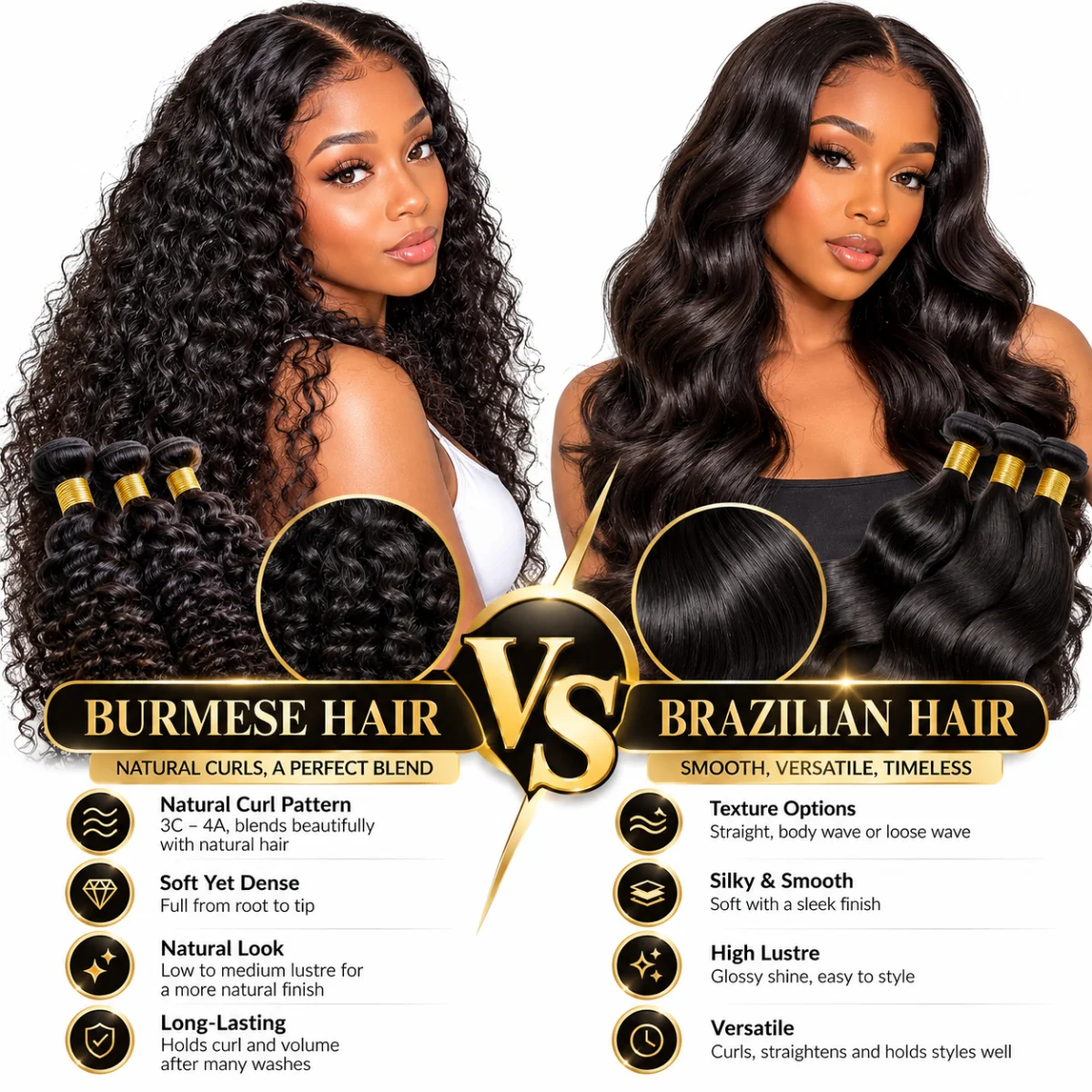
The biggest difference is curl. Brazilian hair sits mostly in the straight to wavy range, while Burmese hair is best known for curly and coily textures. Brazilian hair also has more shine, which looks beautiful on a sleek closure wig but can stand out against natural Afro hair if you are leaving some of your own hair out. In weight, Brazilian bundles often feel heavier, which gives a full look but can mean more tension on the scalp if you install a lot of it.
Popular styles it suits
Brazilian hair is ideal for:
- Sleek straight closure and frontal wigs
- Glamorous body wave installs for weddings and events
- Bob cuts and layered styles
- Colour work such as honey blonde or ombré, because it lifts well
If your goal is a polished, glossy, "done" look rather than a natural textured one, Brazilian hair is hard to beat.
Section 3: Burmese vs Brazilian head to head
Here is how the two compare on the points UK buyers ask about most.
| Feature | Burmese Hair | Brazilian Hair |
|---|---|---|
| Texture | Curly to coily, 3C to 4A; soft but dense with medium to low lustre | Straight, body wave or deep wave; thick, soft and noticeably shiny |
| Longevity | Typically 12 months or longer with good care; can be reused across installs | Typically 6 to 12 months with good care; wavy textures can loosen over time |
| Blending with natural hair | Excellent for 3C to 4B leave-out; low shine matches Afro texture | Best for relaxed, silk-pressed or fully covered styles; shine can contrast with natural hair |
| Ability to dye and heat style | Can be dyed and straightened, but heat and bleach may permanently loosen the curl | Lifts colour well and handles flat irons and curling wands easily |
| Price range in UK market | Premium; usually sits at the higher end because good curly hair is harder to source | Mid-range to premium; wide choice means more competitive pricing |
| Availability in UK | Growing, but fewer specialist suppliers; quality varies widely | Very widely available online and in high street hair shops |
| Best for which hair types | 3C, 4A and 4B natural hair; anyone wanting a natural curly look | Relaxed or straightened hair; anyone wanting sleek, glossy or wavy styles |
The short answer: if you wear your natural texture and want extensions that look like your own hair, Burmese is usually the better choice. If you want sleek, glossy or wavy styles, or plan to colour your hair a lot, Brazilian is easier to work with.
Section 4: How to care for Burmese human hair bundles
Curly hair rewards gentle handling. Treat your Burmese bundles the way you would treat your own curls and they will repay you for a long time.
Washing routine
- Wash every one to two weeks if you wear the hair daily, or after around 10 to 15 wears for a wig.
- Detangle before washing. Never wet a tangled bundle, as water tightens knots.
- Use a gentle, sulphate-less shampoo. Harsh cleansers strip moisture, and unlike your own hair, extensions have no scalp oils to replace it.
- Wash downwards, from weft to ends, rather than rubbing in circles. Rubbing causes matting.
- Always condition. Leave a rich conditioner or hair mask on for 10 to 20 minutes, then rinse with cool water to smooth the cuticle.
Detangling tips
- Detangle while the hair is wet and full of conditioner.
- Start at the ends and work up towards the weft in small sections.
- Use your fingers first, then a wide-tooth comb. Avoid fine-tooth combs and paddle brushes on curly textures.
- Never pull at shedding near the weft. A few hairs are normal; heavy shedding usually means the weft needs sealing.
Drying methods
- Squeeze out water gently with a microfibre towel or cotton T-shirt. Standard towels roughen the cuticle and cause frizz.
- Air dry wherever possible. Lay bundles flat or hang a wig on a stand, curls facing down so they set in their natural pattern.
- If you are short on time, use a diffuser on a low heat, cool setting.
- Do not sleep on wet hair. It tangles badly and can mildew at the weft.
Styling without heat damage
- Refresh curls with a spray bottle of water mixed with a little leave-in conditioner.
- Use a light curl cream or gel and finger-coil any sections that have lost definition.
- For a stretched look, try a twist-out, braid-out or banding instead of a flat iron.
- If you must use heat, always apply a heat protectant and keep tools below roughly 180°C. Bear in mind that repeated high heat can permanently loosen the curl pattern.
- At night, wear a satin bonnet or use a satin pillowcase and loosely pineapple the hair on top of your head to reduce friction.
How long it lasts with proper care
Good quality Burmese human hair bundles commonly last a year or more, and some women reuse the same set across three or four installs. The things that shorten its life are the same every time: heat, bleach, harsh shampoo, sleeping without protection and aggressive combing. Avoid those and your bundles will stay soft and defined far longer.
Section 5: How to choose the right length
Curly hair shrinks. A 16-inch curly bundle will hang noticeably shorter than a 16-inch straight bundle, so always think about the stretched length versus how it will look once the curls spring up. As a rough guide, expect curly Burmese hair to appear 2 to 4 inches shorter than its listed length.
8 to 12 inches: short natural look
Perfect for a curly bob, a tapered style or a look that mirrors short natural hair. These lengths are light, easy to manage and ideal for everyday wear, the office and the gym. They are also a good choice if you are new to curly extensions and want to see how they suit you.
14 to 18 inches: medium length
The most popular range for Burmese curls. Once shrinkage is taken into account, this usually falls around shoulder to collarbone length, which looks full and natural on most face shapes. It works for work, church, date nights and day-to-day wear without feeling like too much hair.
20 to 24 inches: dramatic length
This is where Burmese curls become a statement. Long, voluminous curls that fall down the back are a popular choice for weddings, birthdays, photoshoots and owambe parties. Expect more upkeep, as longer curly hair needs more detangling and product.
26 inches: ultra long
Ultra long curly hair is a show-stopping look, best saved for special occasions, events and content creation. It is heavy, so make sure your install spreads the weight evenly to protect your edges and natural hair. It also takes considerably longer to wash and dry.
Which length suits which occasion?
- Everyday and work: 10 to 16 inches
- Church, family gatherings and casual events: 14 to 18 inches
- Weddings, parties and owambe: 18 to 24 inches
- Photoshoots, performances and content: 22 to 26 inches
When in doubt, choose a couple of inches longer than you think you want. You can always have curly hair shaped and trimmed, but you cannot add length back.
Section 6: Where to buy Burmese hair in the UK
Because Burmese hair commands a premium, it is one of the most commonly mislabelled hair types on the market. Knowing what to look for protects your money and your natural hair.
What to look for in a supplier
- Clear information on origin and processing. A trustworthy seller will tell you whether the hair is Remy (cuticles intact and aligned in one direction), how it is processed, and whether the curl is natural or steam-set.
- Real, unedited photos and videos, ideally showing the hair wet and dry.
- Honest descriptions of curl pattern, length and weight per bundle.
- A UK address and contact details you can actually reach.
- A clear returns policy that sets out what happens if the hair is not as described.
- Genuine reviews from real customers, not anonymous testimonials.
How to spot fake human hair
- The burn test. Snip a few strands from the end of a bundle and burn them over a sink. Human hair burns slowly, smells like burning hair and leaves a fine ash. Synthetic fibre melts into hard beads and smells like plastic.
- The shine test. Hair that looks unnaturally glossy, almost plastic, has often been heavily coated in silicone, or is not human hair at all.
- The wash test. Silicone-coated hair can feel silky in the packet but turns dry and matted after the first wash.
- The tangle test. Non-Remy hair with mixed cuticle direction tangles quickly, especially near the ends.
- Curl memory. Genuine curly hair returns to its pattern when wet. Steam-permed hair often drops its curl after a few washes.
- Thin ends. If the ends are much thinner than the hair near the weft, the bundle is single-drawn or padded with short hair.
Why buying from a trusted UK retailer matters
Buying from a reliable UK-based retailer gives you protection that overseas marketplace sellers often cannot. You have clear consumer rights under UK law, an address and contact details if something goes wrong, and realistic delivery times without surprise customs charges. You are also far more likely to receive what is shown in the photos. With a premium hair type like Burmese, those safeguards matter.
Our recommendation
Whichever hair you choose, the foundation of any good install is healthy natural hair underneath. Before and after wearing extensions, give your own hair the moisture it needs with nourishing natural products such as pure shea butter, and protect both your natural hair and your bundles overnight with a satin bonnet.
You can find natural hair and skin care essentials, including shea butter and satin bonnets, in our beauty collection at RegiPay Stores: Shop the beauty range.
In summary: choose Burmese hair if you want curls that blend with your natural 3C to 4B texture and last across several installs. Choose Brazilian hair if you want sleek, glossy or wavy styles that take colour and heat easily. Either way, buy from a supplier who is open about what they sell, and look after the hair as carefully as you look after your own.