Indomie is one of those foods people eat without ever reading the packet. It is the late-night dinner, the student staple, the thing you make for the children when there is no time to cook, and in many Nigerian homes in the UK it is bought by the carton rather than the pack. So it is fair to ask: how many calories are in Indomie, and what else are you getting in that 70g block of noodles and its two little sachets?
This guide answers the Indomie calories question for the UK, using the nutrition panels printed on 70g Indomie Chicken Flavour packs sold here. It also explains why the numbers vary from one listing to another, what the salt and fat figures mean against UK reference intakes, and how to make a bowl of Indomie into a more balanced meal without losing what makes it good.
Nutrition information changes between factories and recipes. Always check the panel on the pack in your hand, especially if you are counting calories or managing salt for health reasons.
Quick answer: how many calories in a pack of Indomie?
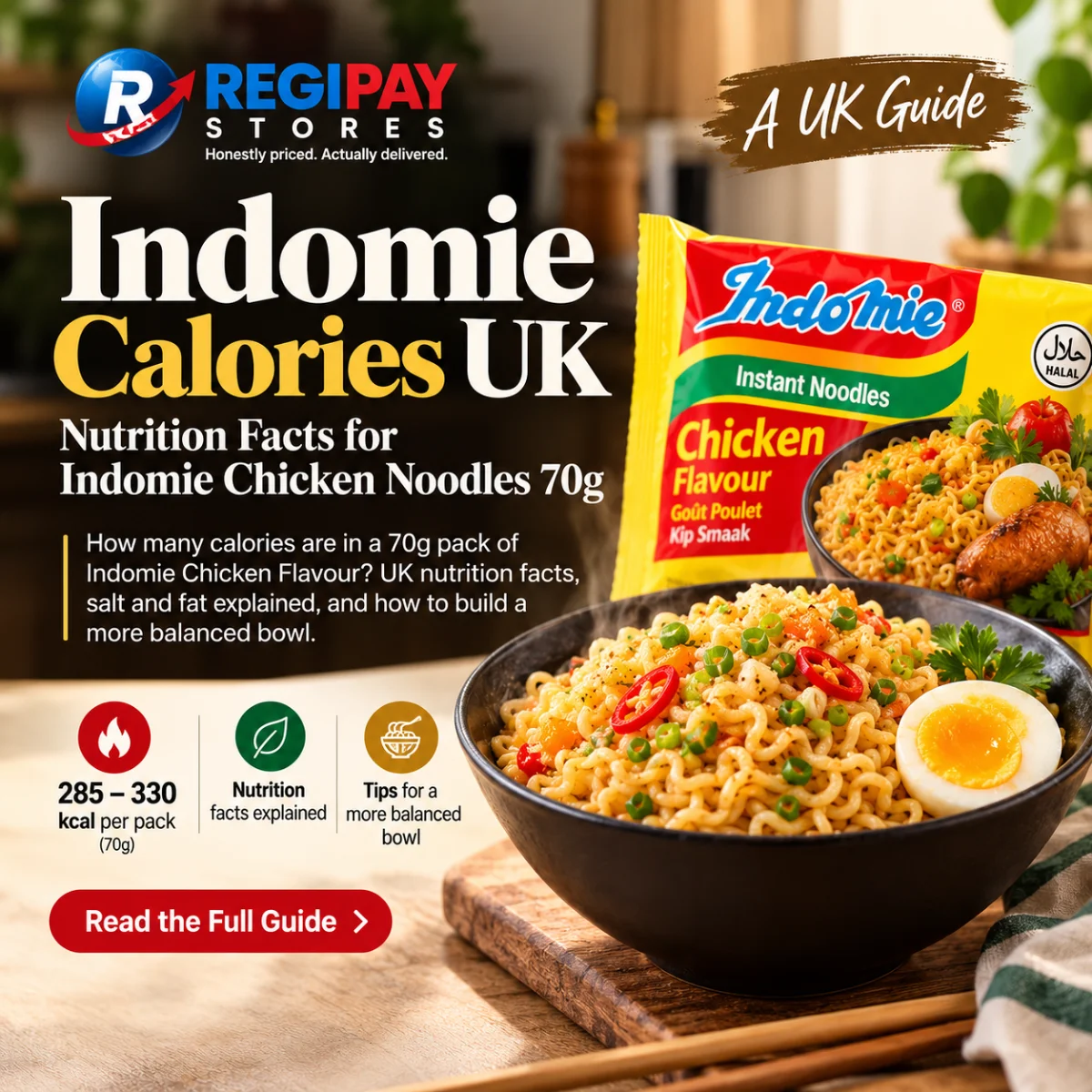
A 70g pack of Indomie Chicken Flavour instant noodles, cooked with all of its seasoning and oil sachets, contains roughly 285 to 330 kcal, depending on where it was made and which retailer's label you are reading.
Nutrition tables from UK retailers and calorie trackers for the 70g chicken pack sit in that range. One major UK supermarket listing shows about 285 kcal per pack, while other UK labels, including packs imported from Nigeria and Ghana, show between roughly 315 and 330 kcal. Per 100g, that works out at around 400 to 470 kcal.
For context, the UK reference intake for an average adult is 2,000 kcal a day, so one pack is about 14 to 16 percent of that.
Indomie chicken 70g nutrition facts (typical UK label)
The table below shows typical values per 70g pack based on UK labels for Indomie Chicken Flavour. Figures are rounded and will differ slightly between production batches and countries of origin.
| Nutrient | Per 70g pack (typical range) | Share of adult reference intake |
|---|---|---|
| Energy | 285 to 330 kcal | about 14 to 16% |
| Fat | 12 to 13g | about 17 to 19% |
| of which saturates | 5 to 6g | about 25 to 30% |
| Carbohydrate | 39 to 45g | about 15 to 17% |
| of which sugars | 1 to 3g | low |
| Fibre | 1 to 2g | low |
| Protein | 6 to 8g | about 12 to 16% |
| Salt | 2.8 to 3.2g | about 47 to 53% |
The reference intakes used here are the standard UK values for an average adult: 2,000 kcal energy, 70g fat, 20g saturates, 260g carbohydrate, 50g protein and 6g salt.
Why do Indomie calories differ between listings?
If you search for Indomie calories you will see a spread of answers, and that is not because anyone is making them up. A few things cause the difference.
Different factories. Indomie is made by Indofood in Indonesia, and under licence in several other countries. In Nigeria, Indomie has been produced locally by Dufil Prima Foods since the late 1980s, and the Nigerian recipe and pack format differ from the Indonesian one. Packs sold in UK African shops are often imported from Nigeria or Ghana, while some supermarket packs come from other plants. Small recipe differences shift the numbers.
Prepared versus dry. Some labels give values for the dry noodles only, others for the noodles cooked with all the sachets, and a few for the product "as prepared" with water. Always check which one you are looking at.
Per pack versus per 100g. A 70g pack and a 100g reference are easy to mix up when you are reading quickly on a phone.
The oil sachet. Most of the fat in Indomie comes from the noodles themselves, which are fried during manufacture, but the seasoning oil sachet adds to it. If you leave it out, the fat and calorie figures drop a little.
What is actually in a pack of Indomie?
Each 70g pack holds a block of pre-cooked, fried wheat noodles and, in the chicken flavour, a seasoning powder sachet and a seasoning oil sachet. Some versions also include a chilli powder sachet.
The noodle block is typically made from wheat flour, palm oil, salt and small amounts of raising agents and stabilisers. The seasoning powder usually contains salt, sugar, flavour enhancers such as monosodium glutamate, onion and garlic powders, and chicken flavouring. The oil sachet is generally palm or vegetable oil with onion.
Allergens. Indomie noodles contain wheat, which means gluten. Depending on the factory, the seasoning may also contain or carry a warning for soya, milk, egg, celery or other allergens. If anyone in your household has an allergy, read the ingredients panel on the actual pack you buy rather than relying on a website listing.
Is Indomie high in salt?
Yes, and this is the figure worth paying attention to. With around 3g of salt per pack, a single serving of Indomie gives you about half of the 6g maximum that UK guidance recommends for adults in a whole day. Under the UK traffic-light labelling system, anything over 1.8g of salt per portion is marked red.
Most of that salt is in the seasoning sachet. The easiest way to bring it down is simple: use half the sachet, or two-thirds, and add flavour in other ways, such as fresh pepper, onion, a little curry powder or a squeeze of lime.
For children, the salt figure matters even more, because the recommended daily maximum is lower: 2g for ages one to three, 3g for four to six, and 5g for seven to ten. A whole pack with all the seasoning would take a young child to or over their daily limit.
Is Indomie fattening?
No single food makes someone gain weight on its own; it depends on the whole day. That said, a pack of Indomie gives you a fair amount of energy, mostly from refined carbohydrate and fat, with relatively little fibre and protein. That combination is filling for a short time but not for long, which is why many people find themselves hungry again an hour or two later.
The saturated fat figure is also on the high side for a snack, at roughly a quarter of the daily reference intake, mainly from the palm oil used to fry the noodles.
Seen honestly, Indomie is best treated as a quick base rather than a complete meal. Eaten occasionally and built up with protein and vegetables, it fits into most diets. Eaten every day on its own with the full sachet, it adds a lot of salt and not much else.
Indomie calories with egg, sausage and other add-ins
Very few Nigerians eat Indomie plain. Here is a rough guide to what the popular add-ins contribute. These are typical values and will vary by size and brand.
| Add-in | Approximate extra kcal |
|---|---|
| 1 medium egg, boiled or poached | 65 to 75 |
| 1 medium egg, fried in a teaspoon of oil | 110 to 120 |
| 1 tablespoon vegetable oil for frying onions and pepper | about 120 |
| Half a tin of sardines in oil, drained | 150 to 180 |
| 2 cocktail sausages | 100 to 130 |
| Half an onion, chopped | 20 to 25 |
| Handful of spinach or cabbage | 10 to 20 |
| Half a fresh tomato and some scotch bonnet | 10 to 15 |
A classic Nigerian-style plate of one pack of Indomie, fried onions and pepper in a tablespoon of oil, and a fried egg, lands somewhere around 520 to 570 kcal. Swap the fried egg for a boiled one, cut the oil to a teaspoon and add a big handful of vegetables, and the same plate comes in nearer 400 to 430 kcal with more protein and fibre.
How to make a more balanced bowl of Indomie
You do not have to give up Indomie to eat well. These small changes make a real difference.
Use less of the seasoning sachet. Half to two-thirds is plenty for most people, especially if you add onion and pepper.
Add protein. An egg, some leftover chicken, a few prawns or a portion of tofu turn a snack into a meal and keep you fuller for longer.
Add vegetables. Spinach, cabbage, carrots, green beans, peppers and frozen mixed vegetables all cook in the same time as the noodles.
Go easy on frying oil. If you fry onions and pepper first, a teaspoon of oil in a non-stick pan is enough.
Mind the portion. A double pack with sausage, egg and extra oil can easily pass 900 kcal. One pack well built-up is often enough.
Drink water with it. The salt will make you thirsty; water is the best answer.
Indomie compared with other UK instant noodles
Most instant noodle packs in UK supermarkets fall in a similar range. Typical 70g to 85g packs from the major brands come in at around 300 to 400 kcal with all seasoning, with salt between about 2g and 4g per pack. Indomie is neither the lightest nor the heaviest; what sets it apart for many people is the taste of the chicken seasoning and the soft but springy texture, which is why it has such a loyal following across West Africa and in the UK diaspora.
Cup and pot noodles are often lower in calories per serving but also smaller, and some are higher in salt per gram. As always, the label is the best guide.
Frequently asked questions
How many calories are in Indomie without the seasoning? The plain fried noodle block on its own is roughly 240 to 280 kcal for a 70g pack, depending on the recipe. Most of the calories are in the noodles rather than the sachets, although the oil sachet adds some.
How many calories are in Indomie Super Pack? Larger packs, usually 120g, scale up accordingly and generally fall in the region of 500 to 560 kcal with all seasoning. Check the specific pack.
Is Indomie suitable for vegetarians? Chicken flavour Indomie may contain chicken-derived flavouring depending on where it is made, so it is not reliably vegetarian. Some factories label their chicken flavour as suitable for vegetarians and some do not. Read the pack.
Is Indomie halal? Many Indomie products carry halal certification from their country of manufacture. Look for the certification mark on the pack you buy.
Can I eat Indomie when trying to lose weight? Yes, in moderation. Keep to one pack, use less seasoning, add protein and vegetables, and count it within your day rather than as an extra.
The bottom line
A 70g pack of Indomie Chicken Flavour has around 285 to 330 kcal, about 12 to 13g of fat and roughly 3g of salt. The calories are reasonable for a light meal; the salt is the figure to watch. Use less of the sachet, add an egg and some vegetables, and Indomie becomes a quick, satisfying dinner rather than just a salty snack.
Stock up on Indomie
If Indomie is a regular in your house, buying by the carton is the simplest way to make sure you never run out. Our Indomie Instant Noodles Chicken Flavour box of 40 is delivered across the UK, and you can find more Nigerian staples in our African and Caribbean groceries range. For cooking ideas, read our guide on how to cook Indomie noodles the way Nigerians actually do.