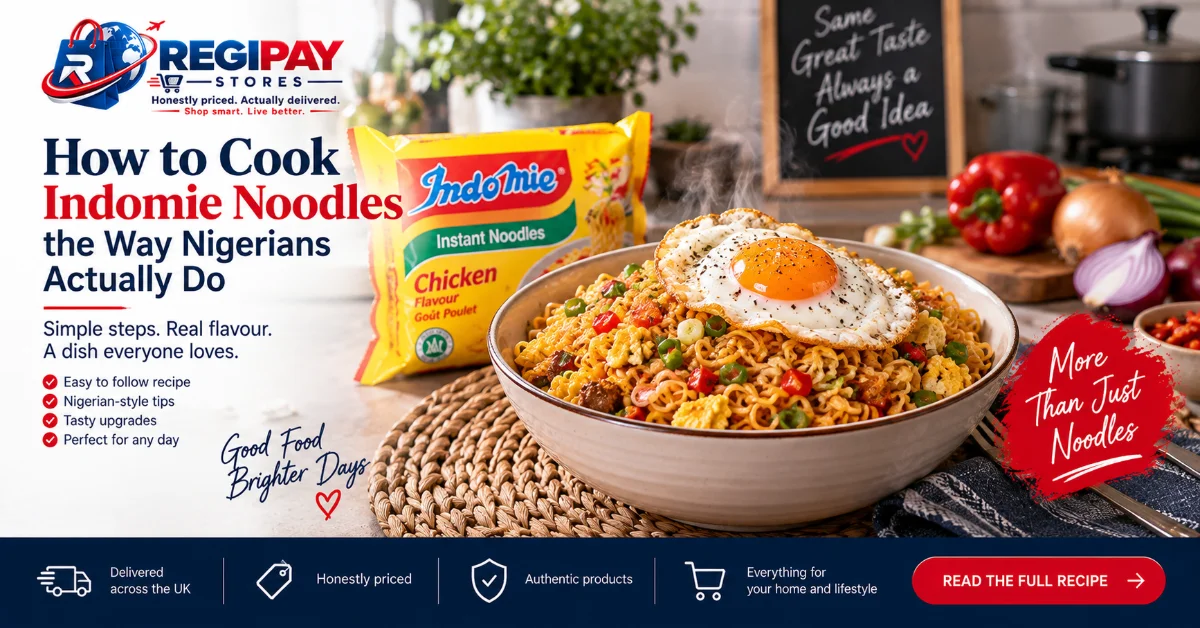
The Nigerian way to cook Indomie is drier and more heavily built than the instructions on the packet. You boil the block in a small amount of water for two to three minutes, drain nearly all of it away, stir the seasoning through so it coats the noodles, and add the oil sachet last with the pan off the heat. The sachets are a base rather than the finished dish, and the egg, pepper, onion and tinned fish that go in around them are what turn a snack into a meal.
This guide covers the base method with real timings, the classic upgrades, honest portion sizes, cooking it for children, the allergens on the label, and whether a box of 40 is worth buying.
Last reviewed September 2026. Prices, pack sizes and availability change, so confirm the current price on the product page before ordering.
What Indomie is, and why it matters in Nigeria
Indomie is a brand of instant fried noodles, Indonesian in origin and also manufactured in Nigeria, where it has become the generic word for instant noodles in the way Hoover became the word for a vacuum cleaner. Ask for noodles in most Nigerian households and you will be handed Indomie.
It is not simply student food there. It is a breakfast, a school lunch, something eaten after a late shift, and the entire menu of small roadside kitchens that cook nothing else, frying it to order with egg and pepper.
We are not going to put a number on any of that, because there is no figure we can stand behind. What matters is the consequence: because it is eaten so often and by everybody, the method has been refined a long way past what is printed on the wrapper.
The base method: Nigerian dry fry Indomie
What is in the packet
Open the wrapper and you will usually find the noodle block plus two or three sachets:
- a seasoning powder, which carries most of the salt and nearly all of the flavour
- a seasoning oil, added at the end rather than during cooking
- on some variants, a separate chilli powder
Check yours rather than assuming, because the contents differ between flavours. Chicken is the default.
The steps
- Put roughly 300ml of water per packet into a small saucepan and bring it to a rolling boil. You want just enough to cover the block, not a full pan.
- Drop the block in whole and leave it alone for the first 30 seconds. Breaking it up straight away shatters it into short pieces.
- Cook for two to three minutes in total, turning the block once and separating the strands with a fork as they loosen. Start testing at two minutes. The noodles want to be pliable with a slight bite still in them, because they carry on cooking after draining.
- Drain, keeping only two or three tablespoons of the cooking water in the pan.
- Return the pan to a low heat, add the seasoning powder and the chilli powder if you have one, and stir for 30 to 45 seconds until the noodles look coated and glossy rather than wet.
- Take the pan off the heat, add the oil sachet, and stir it through for a few seconds.
Why you drain rather than serve the water
The seasoning sachet is calculated for a very small volume of liquid. Leave 300ml in the pan and you get a thin, salty broth with pale noodles in it, and most of the flavour sits in liquid you will not finish. Drain it and the same sachet becomes a coating, which is the whole difference between Nigerian Indomie and instant noodle soup. Keeping two or three tablespoons back still matters, because with a completely dry pan the powder sits in patches and catches on the base.
Why the oil sachet goes in last
The oil sachet is a flavoured oil and its aromatics are volatile, so boiling it loses most of what you paid for. Adding it early also coats the strands, which stops the seasoning powder sticking. Off the heat at the very end, stirred through for a few seconds, is where it works.
The upgrades, done properly
Almost nobody eats it plain. The additions below are not garnish, they are the difference between a snack and dinner.
Egg, three ways
Stirred through is quickest. Beat one or two eggs, and with the seasoned noodles back on a low heat, pour the egg over and stir constantly for 30 to 45 seconds. It sets in ribbons through the noodles and thickens everything slightly. Take the pan off while the egg still looks barely set, because it finishes in the residual heat.
Fried on top keeps the two separate. Fry the egg in a small pan with a little oil, two to three minutes for a set white and a soft yolk, then slide it onto the plated noodles so the yolk breaks into them as you eat.
The omelette wrap takes about as long. Beat two eggs with a pinch of salt, finely diced onion and a little chilli, pour into a wide frying pan over a medium heat, and cook for a minute or two until the top is almost set. Pile the noodles onto one half, fold the other half over, and give it another 30 seconds.
Sardines and corned beef
Tinned sardines in tomato sauce go in at the very end. Pour off most of the oil, flake the fish into large pieces rather than mashing it, add it after the seasoning and warm through for about a minute. Any longer and it disappears into the noodles.
Corned beef goes in at the start instead. Break it up in a little oil over a medium heat for two to three minutes with sliced onion, until it browns in places and stops looking like a block, then add the drained noodles and the seasoning. Browning it first is what stops it tasting of the tin.
Vegetables
Onion, carrot, green pepper, cabbage and spring onion are the usual set, with green beans and sweetcorn close behind. Slice everything thinly, because it has to cook in the time the noodles take.
Fry the harder vegetables, carrot and green pepper and onion, in a tablespoon of oil for two to three minutes before the noodles go in. Cabbage and spring onion need a minute, and anything leafy goes in for the last 30 seconds with the heat off. Vegetables added with the seasoning stay raw, and vegetables boiled with the block come out grey.
A pepper and onion base
This is the version worth learning properly. Blend or finely dice half an onion, a red bell pepper, a tomato and as much scotch bonnet as you can take. Heat a tablespoon of oil, add the mixture and fry it over a medium heat for four to five minutes, until the raw smell has gone, the colour has deepened and it has stopped looking watery.
Add the drained noodles and the seasoning and toss together for a minute. Because the base is already seasoned, half a sachet is often enough, which also takes salt out of the dish. It turns a snack into a meal for another five minutes' work.
Indomie and egg, the street version
The roadside version is two packets, cooked and drained, then fried into a pepper and onion base with two eggs stirred through and more chilli than most people use at home. It is served in a foil pack, closer to a fried noodle dish than anything soupy. Use two packets but only one and a half seasoning sachets, because two plus a pepper base is too salty.
The two packet rule and honest portions
One 70g packet is a snack. It is not a meal for an adult, and the packet does not claim otherwise, it simply does not say so. Most adults in Nigeria cook two packets at once, which is 140g of dry noodles and a reasonable main meal on its own.
The useful middle ground is one packet plus an egg and a handful of vegetables, a genuine light lunch out of a single block. Two packets, two eggs and a pepper base will feed two people if there is something else on the table. For children, half a packet to one packet is the sensible range depending on age and appetite.
Three ways to cook it, compared
| Method | Hands-on time | Effort | What you get | Best for |
|---|---|---|---|---|
| Packet instructions | About 3 minutes | Boil, tip both sachets in, serve in the water | Thin salty broth with pale noodles and diluted seasoning | Being very hungry and very short of time |
| Nigerian dry fry | 5 to 6 minutes | One pan, one draining step, stirring at the end | Coated, glossy noodles with the seasoning actually on them | The everyday default, and the one to learn first |
| Pepper and onion base | 10 to 12 minutes | Chopping or blending, a second frying step, usually an egg too | A proper meal with heat, sweetness from the onion and pepper, and body from the egg | Dinner, guests, or making one packet feed a person properly |
The packet method is in the table because it deserves to be. It is a perfectly reasonable way to eat noodles in three minutes, just a weaker version of the same ingredients.
Cooking it for children, salt and allergens
For children
Cook it dry rather than wet, because a drained pan is far easier for a child to eat than a bowl of hot liquid. Use half the seasoning sachet, none of the chilli powder, and less of the oil sachet, which carries much of the pepper heat in some variants.
Stirring an egg through is the simplest way to turn one packet into a meal for a child, and finely grated carrot disappears into it without argument. Let it stand a minute before serving, because noodles hold heat longer than they look.
Salt
The seasoning sachet is where nearly all the salt in the dish comes from. Using half of it and building the rest of the flavour with onion, pepper, garlic and tomato is the simplest way to cook it with less salt, and it tastes better, which is a rare combination.
The salt and nutrition figures are on the wrapper of the packet in front of you, and that is the only source worth quoting. Anyone with dietary concerns, including about salt, should speak to their GP or a registered dietitian rather than relying on the internet.
Allergens
The label on the boxes we stock declares cereals containing gluten and soya. The block is wheat based, so the gluten declaration follows, and soya appears in the seasoning. It is not suitable for anyone with coeliac disease or a soya allergy. Read the label on the box you have, since declarations change.
Buying a box against singles, and storing it
Instant noodles are one of the few things where buying by the box is straightforwardly cheaper rather than merely convenient. The Indomie Instant Noodles Chicken Flavour box of 40 x 70g is £20.99 at the time of writing (October 2026), about 52p a packet, and the current price is on the product page.
Whether a box suits you comes down to two questions. Will you get through 40 packets before the best before date, and have you somewhere to put a 2.8kg box. A household eating Indomie once or twice a week will finish it comfortably. Somebody who buys a packet now and then will not, and singles suit them better despite the higher price each.
Standard UK delivery is £7.99 and free on orders of £100 or more, with most items estimated at 3 to 7 working days from dispatch, so a box is worth adding to a wider order from the African and Caribbean groceries shelves.
Storage and shelf life
Keep the box somewhere dry, dark and cool, away from the hob and the kettle. The blocks are fried during manufacture, which is what lets them cook in three minutes, and also why they taste of old oil after years in a warm cupboard.
Each packet carries a best before date, which is about quality rather than safety. Blocks past it are flatter and duller, and the seasoning loses its edge first. Once the box is open, leave the individual packets sealed until you cook them, because a British kitchen is damper than most people think, which is the same reason Ijebu garri needs an airtight container.
Frequently asked questions
How long do you cook Indomie noodles for?
Two to three minutes in boiling water is enough for a 70g block. Start testing at two minutes and take it out while there is still a slight bite, because it carries on cooking once drained. Overcooked Indomie breaks up as soon as you stir the seasoning in.
Do you drain Indomie noodles?
Yes, if you are cooking them the Nigerian way. Drain off nearly all the water and keep two or three tablespoons, so the seasoning coats the noodles instead of dissolving into a thin soup. The packet instructions leave the water in, which is why packet Indomie tastes weaker.
How do you cook Indomie with egg?
Beat the egg and pour it over the drained, seasoned noodles on a low heat, stirring for 30 to 45 seconds until it sets in ribbons. Or fry the egg separately and lay it on top, or make a two egg omelette and fold the noodles inside. All three take roughly the same time.
Is one packet of Indomie enough?
For an adult, generally not. One 70g packet is a snack, and two is the normal portion for a main meal in Nigeria. One packet plus an egg and some vegetables makes a reasonable light lunch.
Can you cook Indomie without the seasoning?
Yes, and it is worth doing occasionally. Cook and drain the block as usual, then build the flavour with fried onion, pepper, garlic and tomato. It takes longer and gives full control over the salt.
Does Indomie contain gluten?
Yes. The label declares cereals containing gluten and soya, because the noodle block is wheat based and the seasoning contains soya. It is not suitable for anyone with coeliac disease or a soya allergy, so check the label on the box you have.
Choosing your box
If Indomie is already part of the weekly rotation in your house, the Indomie box of 40 x 70g packets at £20.99 at the time of writing (October 2026) is the sensible way to buy it, with the current price shown on the product page. If it is not, buy a few singles first, cook one the way described above with an egg stirred through, and see whether it earns a place.
If you are building the rest of the cupboard from scratch, our guide to pounded yam with poundo flour covers the other end of the same shopping list.