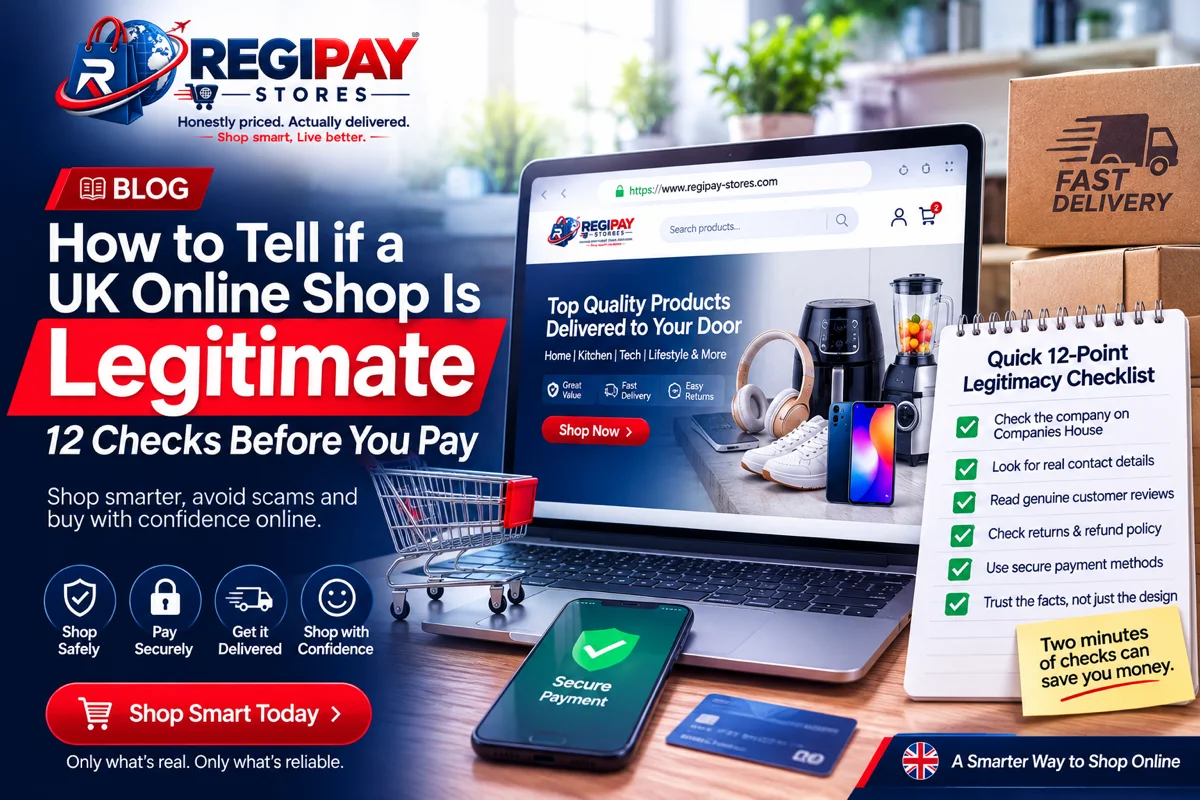
There is something slightly odd about a retailer publishing this article, and it is worth addressing directly: every check below can be applied to us, and we would rather you did. A shopper who knows how to verify a seller is a shopper who buys with confidence, and the businesses that lose out are the ones hoping you will not look.
The uncomfortable truth about online shopping fraud in the UK is that it very rarely involves anything technical. Nobody is hacking your computer. They build a plausible-looking shop, run cheap social media adverts, take card payments or bank transfers for a few weeks, and disappear before the complaints reach anyone who can act. The defence is not antivirus software. It is two minutes of checking before you enter a card number.
Last reviewed August 2026. Payment protection rules, reporting routes and the financial thresholds mentioned here all change over time — confirm the current position with your own bank, on GOV.UK, or with the free Citizens Advice consumer service before acting on it.
Why a padlock and a nice website prove nothing
The padlock icon means traffic between your browser and the site is encrypted. It says nothing whatsoever about who is at the other end. Certificates are free and take minutes to obtain, so a fraudulent shop has exactly the same padlock as a legitimate one. Treat its absence as disqualifying and its presence as meaningless.
The same goes for design. Website templates are cheap, and product photography can be lifted wholesale from the real manufacturer. A polished shop is now easier to build than a shabby one, so appearance has stopped being evidence of anything.
Five checks that take two minutes
1. Look the company up on Companies House
Every UK limited company appears on the free Companies House register. Search the company name from the website footer. You are looking for four things: that it exists, when it was incorporated, whether accounts and filings are up to date, and whether the registered address matches what the site claims.
A company incorporated three weeks ago selling deeply discounted furniture is not automatically fraudulent, but it is a reason to pay by credit card and to keep the order small.
2. Check the VAT number
If a site displays a VAT number, verify it using the free "Check a UK VAT number" service on GOV.UK. It will confirm the number is valid and show the registered business name and address. A VAT number that does not validate, or validates to a completely different company, is the single strongest red flag on this list.
A legitimate small business may be below the VAT threshold and have no number at all, which is fine. Displaying a fake one is not.
3. Find a real address and a real way to contact them
You want a full trading address, not just a postcode, and ideally a phone number or a direct email rather than a contact form alone. Then put the address into a mapping service and look at it. A registered office at an accountancy firm is normal. A "head office" that turns out to be a residential flat or a mailbox service, on a site claiming to be a large retailer, is not.
4. Check how old the domain is
Free WHOIS lookup tools show when a domain was registered. Most fraudulent shops operate on domains a few weeks or months old, because the previous one has already been reported. A domain registered years ago and continuously in use is a genuinely difficult thing to fake.
Also read the domain itself carefully. Lookalike domains that swap a letter, add a hyphen, or append a word to a well-known brand name are a common tactic, and they are easy to miss at a glance in a social media advert.
5. Look at which payment methods are offered
This is the most reliable single check on the list. A legitimate UK retailer accepts card payments through a recognised processor. Be very cautious if a site pushes you towards a bank transfer, a payment app, a cryptocurrency wallet, or a gift card. Those routes exist in fraud precisely because they are hard to reverse.
If a site offers cards but the checkout redirects somewhere that looks unrelated to the shop, stop.
Four checks on the product listing
6. Is the price plausible?
Retail margins on branded goods are thin. A current-model item at 70% below every other seller is not a bargain somebody has overlooked; it is either not the item described, not in stock, or not coming. Price is the bait, and it works because it makes people skip every other check on this list.
7. Reverse image search the photos
Right-click a product image and search it. If the same photograph appears on dozens of unrelated shops, you are looking at a dropshipping operation reusing supplier photography. That is not fraud in itself — plenty of legitimate retailers use supplier images, and we do too — but combined with a new domain and no company details it is a pattern.
What should concern you is a photograph lifted from a well-known brand's own site for a product being sold under a different name.
8. Are the specifications real?
Genuine listings contain awkward, specific numbers: dimensions in centimetres, weight capacities in kilograms, materials, wattages. Fraudulent and low-effort listings contain adjectives. If you cannot find out how big something is or what it is made from, the seller either does not have it or has never seen it.
9. Is there real delivery and stock information?
A specific delivery window, a named carrier or a stated dispatch time suggests a business that actually ships things. "Fast worldwide delivery" with no timescale suggests one that does not.
Three checks on reputation
10. Read the review pattern, not the score
Fake reviews cluster. Look for a burst of five-star reviews all posted within a short window, all of a similar length, all praising the site rather than a specific product, and none mentioning anything mildly negative. Genuine review profiles are messier: they span months, they mention specific items, and a proportion of them complain about delivery.
Also check whether the reviews are on the site itself, where they can be curated, or on an independent platform where they cannot be deleted.
11. Look for the company where it cannot control the conversation
Search the company name alongside words like "scam", "review" or "refund", and look at forums, Reddit and consumer sites rather than the first page of marketing results. A retailer with a real customer base has a real footprint, including complaints. A retailer with nothing at all outside its own site and its own adverts is either brand new or deliberately disposable.
12. Check the age and behaviour of the social accounts
An account created two months ago, posting only adverts, with comments disabled or full of unanswered questions about undelivered orders, tells you what you need to know. Comment sections on paid social adverts are frequently the fastest way to find out that a shop is not delivering.
The summary table
| Green flags | Red flags |
|---|---|
| Company on Companies House with filings up to date | No company name anywhere on the site |
| VAT number that validates on GOV.UK | VAT number that does not validate |
| Full trading address and a phone number | Contact form only, no address |
| Domain several years old | Domain registered weeks ago |
| Card payment through a known processor | Bank transfer, crypto or gift cards pushed |
| Specific dimensions, weights, materials | Adjectives instead of specifications |
| Delivery windows and named carriers | "Fast worldwide delivery", no timescale |
| Review history spanning months, some negative | Burst of generic five-star reviews |
| Prices in line with the market | Prices far below every other seller |
| Returns policy in plain English | No returns policy, or one that contradicts UK law |
No single red flag is proof. Three together is a decision.
Pay so that you can get your money back
Assume, occasionally, that you will be wrong. How you pay determines whether that costs you anything.
Credit card is the strongest position. For purchases between £100 and £30,000, Section 75 of the Consumer Credit Act makes the card provider jointly liable with the retailer, which means you can claim directly from your bank.
Debit card gives you chargeback. It is a card scheme rule rather than a statutory right, and the window is typically around 120 days, but it works.
PayPal and similar carry their own buyer protection schemes with their own time limits. Read them once so you know what you have.
Bank transfer is the weakest. Rules introduced in late 2024 require UK banks to reimburse most victims of authorised push payment fraud, which is a significant improvement, but the process is slower and less certain than a card claim. Avoid paying an unfamiliar shop this way at all.
If you have already paid
Act the same day if you can.
Contact your card provider or bank first and ask specifically about a Section 75 claim or a chargeback. Do not wait to see whether the goods turn up; you can withdraw a claim, but you cannot recover a missed deadline.
Report it to Action Fraud, which is the national reporting centre for England, Wales and Northern Ireland. In Scotland, report to Police Scotland on 101. Reporting matters even when you get your money back, because it is how patterns get spotted.
Free advice is available from the Citizens Advice consumer service, which also refers matters to Trading Standards.
Then change any password you reused on that site, and watch the card for small unfamiliar transactions, which are often used to test whether a card is live.
Apply all of this to us
We would rather you checked. Our company details, VAT registration where applicable, trading address and returns policy are on the site, and our delivery windows are the supplier's real dates rather than rounded-down estimates. Our product listings carry dimensions in centimetres, weight capacities in kilograms and materials, because that is what you need to decide — compare a bed frame or a store cupboard staple against the checks above and see how we do.
If anything on our site fails one of the checks above, tell us and we will fix it. That is a better outcome for us than a cautious customer who quietly closes the tab.
Frequently asked questions
Does a padlock in the address bar mean a site is safe?
No. It means the connection is encrypted, nothing more. Certificates are free and fraudulent sites have them too. Its absence is a reason to leave; its presence is not a reason to trust.
How can I check if a UK company is real?
Search the company name on the free Companies House register, which shows incorporation date, registered address and filing history. If the site displays a VAT number, verify it separately using the "Check a UK VAT number" service on GOV.UK.
Is it safe to buy from a brand new online shop?
It can be, but treat it as higher risk. Pay by credit card, keep the first order small, and check that the company is registered and that there is a real address and contact route. New is not the same as fraudulent; new with no verifiable details is different.
What should I do if a shop takes my money and disappears?
Contact your card provider immediately about a Section 75 claim, for credit purchases over £100, or a chargeback for debit cards. Report it to Action Fraud, or Police Scotland on 101 in Scotland, and get free advice from the Citizens Advice consumer service.
Are all dropshipping sites scams?
No. Dropshipping is a legitimate fulfilment model and many established retailers use it, which is why supplier photography turns up on multiple sites. What matters is whether the business behind it is identifiable, contactable and accountable when something goes wrong.
Two minutes well spent
Run three checks before you enter a card number on any shop you have not used before: search the company on Companies House, validate the VAT number if one is displayed, and look at the payment methods offered. Those three catch the overwhelming majority of problems. Then pay by credit card, keep the confirmation email, and shop with rather more confidence than the average person does.