Choosing a bed size is really two decisions: how much sleeping width you need, and how much floor space you are willing to give up to get it. Most people get the first one right and the second one wrong, then find the wardrobe door no longer opens fully.
This guide covers every UK bed size in feet and centimetres, which rooms each size realistically suits, how high a bed should sit, and the three measurements worth taking before you order anything.
Last reviewed September 2026. Prices, pack sizes and availability change, so confirm the current price on the product page before ordering.
The standard UK bed sizes, smallest to largest
These five sizes account for almost every bed and mattress sold in Britain. All figures are mattress dimensions.
| Size | Imperial name | Centimetres | Feet and inches |
|---|---|---|---|
| Single | 3ft | 90 x 190cm | 2'11" x 6'3" |
| Small double | 4ft | 120 x 190cm | 3'11" x 6'3" |
| Double | 4ft6 | 135 x 190cm | 4'5" x 6'3" |
| King | 5ft | 150 x 200cm | 4'11" x 6'7" |
| Super king | 6ft | 180 x 200cm | 5'11" x 6'7" |
Two things in that table catch people out. The imperial names are rounded rather than exact, so a 4ft6 double is actually 4 feet 5 inches wide and a 5ft king is 4 feet 11 inches. And the length changes at king: singles, small doubles and doubles are 190cm long, while kings and super kings are 200cm. If anyone sleeping in the bed is over about 6ft tall, that extra 10cm of length will matter more than any amount of extra width.
Start with who is sleeping in it, not the room
Width per sleeper is the number that decides whether a bed feels generous or cramped.
- One adult: a 3ft single at 90cm is fine for sleeping, but a 4ft small double at 120cm is the point where you can starfish and read in bed comfortably.
- Two adults: a 4ft6 double gives each person 67.5cm. That is less width each than a child gets in a 3ft single. It works, and most of the country sleeps this way, but it is tighter than people expect.
- Two adults who want room: a 5ft king gives 75cm each and a 6ft super king gives 90cm each, which is a full single's width per person.
- A child or teenager: a 3ft single is the standard. Choose the frame for storage and safety rather than the size.
If one of you is a restless sleeper, or a child or a dog joins you in the morning, going up one size does more for sleep quality than almost anything else you can buy.
Then check the room, not the bed
A bed needs clear floor around it, not just the space it stands on. Leave 60 to 75cm on any side you walk down, and closer to 90cm if two people need to pass or a wardrobe door swings into that space.
As a rough guide for UK bedrooms:
- Under 3 x 2.5m: single or small double, with the bed against a wall
- Around 3 x 3m: double, with access down one or both sides
- 3.5 x 3m or larger: king
- 4 x 3.5m or larger: super king with walking space all round
Before you commit, mark the bed's footprint on the floor with masking tape and live with it for a day. It takes ten minutes and it settles the argument.
Mattress size and frame size are two different numbers
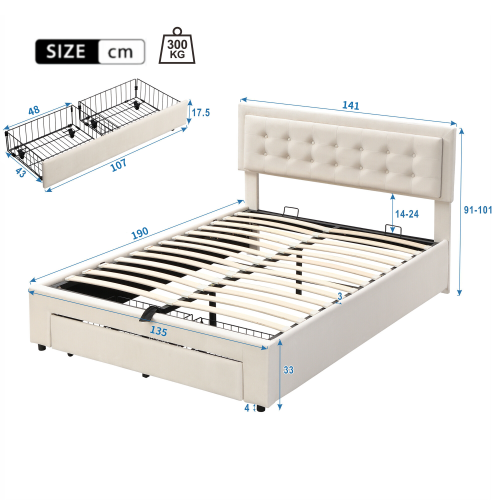
Every size in the table above is a mattress measurement. The frame around it is always bigger, and by an amount that changes from model to model. A slim metal frame might add 5cm each side. An upholstered frame with a padded surround can add 15cm each side, and a headboard adds depth at the top.
So the sequence is: choose the mattress size for the people sleeping in it, then check that specific frame's external width, length and headboard height against your room. Every listing worth buying from publishes those external dimensions. If a listing only gives you the mattress size, treat that as a reason to ask before ordering.
Our UK bed sizes explained guide has the full size table in cm, inches and feet, plus the doorway and staircase checks in more detail.
How high should a bed be?
Most UK beds put the top of the mattress somewhere between 55 and 65cm off the floor, and that range exists for a reason: it puts the mattress roughly level with your knee, so you can sit on the edge with your feet flat on the floor and stand up without pushing off.
- Platform and low frames: 45 to 55cm to the mattress top. Modern look, harder to get out of if you have stiff knees or hips.
- Standard frames and divans: 55 to 65cm. The comfortable default for most adults.
- Ottoman and high storage frames: often 65cm or more once the mattress is on, because the storage box sits under the slats.
Height matters twice over if you are buying a storage bed. An ottoman lifts the whole platform upwards on gas struts, so you need clear headroom above the bed, not just space around it. A sloping ceiling or a low window sill at the head end can stop the lid opening fully.
Sizes that sit outside the standard five
You will also see these names, mostly from specialist makers rather than mainstream retailers.
- Small single, 2ft6 — 75 x 190cm. Box rooms, bunk beds and cabin beds.
- Three-quarter, 3ft6 — 107 x 190cm. Sometimes called a 3/4 bed. Wider than a single, narrower than a small double, and genuinely hard to buy bedding for.
- Emperor — usually 200 x 200cm, though it varies by maker.
- Caesar — around 244 x 200cm, and super Caesar around 270 x 200cm.
Treat everything below super king as a specialist order. None of these are standard, so bedding, mattresses and replacement slats all become harder to source, and you will usually be buying from the one maker who built the frame.
Three measurements to take before you order
- The room. Wall to wall, then subtract the bed's external frame width and length. What is left is your walking space. Under 60cm on the side you use daily is a daily annoyance.
- The route in. Narrowest doorway, the turn at the top of the stairs, and the landing. A 190cm mattress does not bend round a tight turn, and a flat-packed frame arrives in boxes that are longer than you expect.
- The headroom, if you are buying an ottoman or a high-headboard frame. Measure from floor to ceiling at the head end, and from floor to the underside of any window or sloped ceiling.
Choosing from our range
We stock singles and doubles rather than kings, which suits box rooms, children's rooms, guest rooms and most UK second bedrooms.
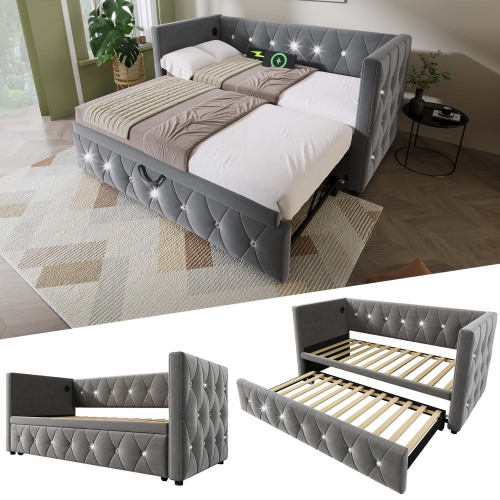
- Upholstered 3ft single bed with pull-out trundle — 90 x 190cm, with a second 90 x 190cm bed underneath. The best answer to a small room that occasionally sleeps two.
- Wooden 3ft single storage bed with safety guardrail — 90 x 190cm with two drawers, built for a child's room.
- Upholstered 4ft6 double in velvet with storage — 135 x 190cm, the standard UK double.
- Double ottoman bed with hydraulic storage and surround LED — 135 x 190cm, with the whole platform lifting for storage.
- Staircase bunk bed with storage cube — two 3ft singles stacked, with stairs instead of a ladder.
The full range is in our furniture category, and delivery is free on UK orders over 100 pounds.
Frequently asked questions
What is the most common bed size in the UK?
The 4ft6 double at 135 x 190cm. It is the default for main bedrooms and the size most UK bedding is cut for.
How many feet is a double bed?
A UK double is 4ft6 wide, which is 4 feet 5 inches or 135cm, and 6ft3 long, which is 190cm.
Is a 5ft bed a king size?
In the UK, yes. A 5ft bed is a king at 150 x 200cm. Be careful with the word king online, though, because a US king is 193 x 203cm and much wider.
What is the standard height of a bed in cm?
Most UK beds put the mattress top 55 to 65cm from the floor. Low platform frames sit at 45 to 55cm, and ottoman frames often sit above 65cm.
What size beds are there in order?
Small single 2ft6, single 3ft, three-quarter 3ft6, small double 4ft, double 4ft6, king 5ft, super king 6ft, then the non-standard emperor and Caesar sizes above that.
Are all UK mattresses the same length?
No. Singles, small doubles and doubles are 190cm long. Kings and super kings are 200cm.