An ottoman bed is worth it if you are short of storage and short of floor space, because it turns the whole footprint under the mattress into one deep compartment you can see into at a glance. In a flat with no loft, no garage and no spare cupboard, nothing else in the bedroom comes close. It also costs more than a plain frame, it is heavy, the gas struts are a wear part rather than a lifetime fitting, and in a room with a sloping ceiling or no clearance beside the bed it is the wrong bed.
This guide covers how the lift works, which opening direction suits which room, the headroom you need, what to store and what to keep out, how struts fail, and how an ottoman compares with drawers and boxes.
Last reviewed September 2026. Prices, pack sizes and availability change, so confirm the current price on the product page before ordering.
What an ottoman bed actually buys you
The space under an ordinary bed frame is technically storage and practically wasted. It is low, dusty, usually split by a centre support rail, and reachable only on your hands and knees.
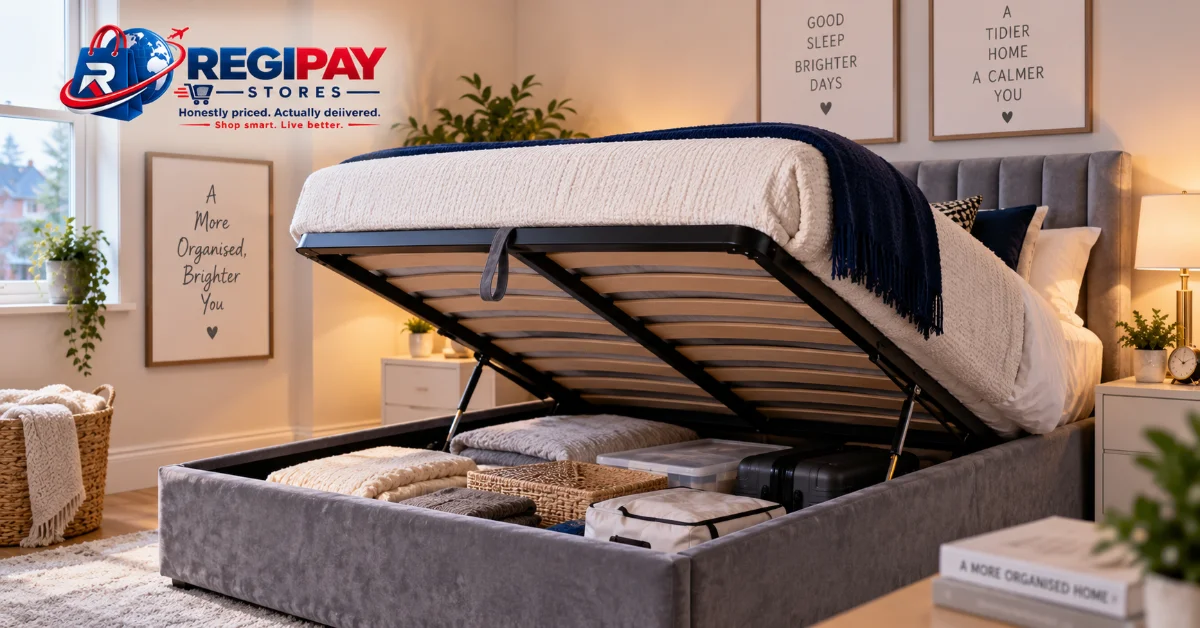
An ottoman replaces that with one enclosed box the size of the mattress, commonly around 20 to 30cm deep, opened by lifting the base and mattress together on gas struts. Everything is visible at once, and it takes the bulky things that eat wardrobe space. In a small bedroom that is a chest of drawers you did not have to find floor for.
The costs are real too. You pay more than for a plain frame of the same size, the bed is heavier to move and assemble, and you have added a mechanism that can fail. The storage also sits under the mattress, which makes it occasional-access, not somewhere for anything you touch during the week.
How the lift works, and which way it should open
The lifting is done by gas struts, sealed cylinders of pressurised nitrogen that push a rod out steadily. They carry most of the weight of base and mattress, so what you lift is a fraction of the real load. Struts are rated in newtons and matched to a mattress weight range, which is why the maximum mattress weight on a listing matters.
The base pivots on a hinge line along one edge, the opposite edge rises, and the struts hold it short of vertical while you load or unload.
Side-opening
The hinge runs along one long side and you lift from the opposite one, so you need standing room down a long side and clearance above the hinge side. It is the lower-effort option because you lift a shorter distance. The catch is that a wide mattress wants to slide as the base passes about forty-five degrees, so check for a retaining strap.
End-opening
The hinge runs across the head end and you lift from the foot, so the mattress swings up and over towards the headboard. You need floor clearance at the foot and headroom above the head. End lift is usual on kings and super kings, because the mattress is supported along its length and slides less, and it suits a bed in an alcove where only the foot is accessible.
Which suits which room shape
Free floor on both long sides and either works, with side lift the less effort. In an alcove or between wardrobes, end lift is the only sensible choice. Under a low ceiling or a sloping roof at the head, end lift will not open at all.
The awkward case is a bed against a wall along one long side. A side lift still works, but only if the hinge is on the wall side, so ask whether the bed can be built to open either way. Many can. Some cannot.
The headroom question nobody checks
When the base rises it sweeps an arc whose radius is the length of the bed on an end lift, or the width on a side lift, measured from the hinge line. An end-lift double sweeps close to 190cm upwards from the head end, and although the base stops short of vertical, plan as though it does not.
That arc runs into sloping ceilings in loft rooms and dormers, shelves and picture rails above the headboard, wall lights, deep coving and windows that open inwards.
The check takes two minutes. Stand a broom handle upright at the hinge line and swing it through the arc the base will travel. If it hits something, so will your bed. This is why an ottoman is wrong for most loft conversions with the head under the slope, though a side lift sometimes rescues it in a wide room.
What to put inside, and what to keep out
An ottoman is at its best holding things you need a few times a year and want out of sight in between.
- Spare duvets, pillows, blankets and complete bedding sets.
- Out-of-season clothing and coats, in breathable bags.
- Empty suitcases and holdalls, the single best use of the space.
- Spare curtains, wrapping paper and camping gear.
- Toys out of rotation, where an adult does the opening.
Keep several things out. Anything damp, which is covered below. Anything you need weekly, because clearing the pillows and duvet to reach a phone charger is a system nobody sticks to. Anything sharp or loose enough to foul the hinge or the strut mountings. Aerosols, paint and solvents. Documents you might need at short notice.
Weight is often described wrongly. The stored contents sit in the fixed lower box and do not rise with the base, so a full compartment does not make the lift heavier, though piling things high presses on the underside of the deck and stops it seating properly. What genuinely affects the lift is the mattress, and one heavier than the struts were specified for makes the base hard to start and quick to close. Heavy items are awkward to haul over a side rail anyway, so tools and boxes of books belong elsewhere.
Damp, ventilation and enclosed storage
British bedrooms are damp. Moisture comes off people breathing overnight, off clothes drying indoors, and out of cold walls in winter. An ottoman compartment is enclosed, unheated, sits on the coldest surface in the room and has very little airflow.
Store things bone dry or not at all. Bedding off an airer that feels almost dry is not dry, and a fortnight in a cold box is how a duvet ends up smelling of a church hall. Use breathable cotton bags rather than sealed polythene, which traps whatever moisture went in with it. Open the base for an hour every month with a window ajar.
Check the deck as well. Slats let the mattress breathe from below. A solid board does not, and a mattress on one in a cold room can collect condensation underneath, so air it now and then.
If a room has a genuine damp or mould problem, do not use enclosed storage in it until the damp is dealt with. Persistent damp and mould in a home is a matter for your landlord or local council, and if anyone in the household is affected by it, speak to a GP.
Weight, delivery and assembly
An ottoman is heavier than a plain frame of the same size, because it has thicker side rails, a full lower box, a deck, upholstery and steel lifting arms. The cartons are long as well as heavy.
Treat it as a two-person item twice over. Two to get the cartons up the stairs, and two to fit the struts, because the base must be held at the right angle while each strut is clipped into place. Fitting struts alone is how they get bent and how people get hurt.
Access matters more than with an ordinary bed, since ottoman bases often arrive part-assembled as large rigid pieces that cannot be turned in a tight stairwell. Measure the doorway, the narrowest point of the stairs and the landing turn first. Our guide to UK bed sizes covers how to take those measurements.
Check what the delivery service includes, because kerbside, doorstep and room of choice are three different things. Our standard UK delivery is £7.99, free over £100, with most items estimated at 3 to 7 working days from dispatch.
Gas struts are a wear part
Gas struts lose pressure slowly over their working life. That is normal rather than a defect, and it is the one part of an ottoman bed you should assume will need attention.
A failing strut announces itself clearly. The base needs a real shove to start rising rather than moving with a light pull. It stops partway up and sinks back, or no longer holds itself open, or drops faster than it should on the way down. One side lifts before the other, putting the frame out of square.
Replacing them is straightforward. Struts are a standard component, matched on three things: extended length, stroke, and the newton rating printed on the cylinder. Change them in pairs, since a fresh strut working against a tired one twists the base.
What matters more is the meantime. Do not prop a failing base with a broom handle. Do not let a child operate a base that will not hold itself open. Do not put your head or arm under a base you do not trust.
Ottoman against the other storage options
| Option | Storage volume | Floor space to use it | Cost | Ease of reaching |
|---|---|---|---|---|
| Ottoman base | Whole bed footprint, commonly 20 to 30cm deep | One side or the foot, plus headroom for the arc | Highest | All visible at once, but clear the bed first |
| Divan with two or four drawers | A third to a half of an ottoman, nothing in the middle | 60 to 70cm beside each drawer | Middle | Easy, no lifting, fine weekly |
| Under-bed boxes on a plain frame | Least, limited by under-bed clearance | Room to pull each box clear | Lowest by a wide margin | Easy but on your knees, lids collect dust |
| Bed with a storage headboard | Small, books and chargers not bedding | None extra | Low, part of the frame price | Easiest of the four, genuinely daily |
Read that as a set of jobs, not a ranking. A storage headboard and an ottoman do not compete, because one handles what you touch nightly and the other what you touch twice a year. Drawers sit in between, and suit clothes you wear every week.
Who should not buy an ottoman bed
Anyone with a sloping ceiling, a low ceiling or a shelf above the head of the bed, unless a side lift clears the arc. Anyone whose bed sits tight against walls on the sides and the foot, because there is nowhere to stand and lift from.
Anyone who wants weekly access to what goes inside, because the bed has to be cleared of pillows and duvet every time, and a storage system that is mildly annoying stops being used by March.
Anyone for whom lifting a mattress edge is uncomfortable. The struts do most of the work, but you take the initial weight, and a bed you cannot open easily is just a heavy bed. If back or shoulder pain is the reason you are hesitating, that is a question for a GP or physiotherapist rather than a furniture shop.
People who move house often, since ottomans are heavy and have more parts to lose. Households on a tight budget, where under-bed boxes do a decent share of the job for far less. And rooms with a known damp problem.
What to check on a listing before you order
- The lift direction, side or end, and whether it can be built to open either way.
- Internal storage depth in centimetres, and whether the compartment is divided.
- Whether the deck is slatted or a solid board.
- The maximum mattress weight the struts are rated for.
- Whether a mattress is included, which often it is not.
- Whether a mattress retaining strap is fitted, particularly on a side lift.
- External frame dimensions and total height, checked against your room.
- Weight, number of cartons and the length of the longest one.
- Whether the warranty covers the mechanism as well as the frame.
Frequently asked questions
Are ottoman beds worth the extra money?
They are worth it in a small room with no loft or spare cupboard, where the storage replaces furniture you would otherwise need floor space for. They are poor value in a house with plenty of storage already, or in a room where the base cannot open properly.
How much space do you need to open an ottoman bed?
You need standing room on the side or end you lift from, so around 60 to 70cm of clear floor, plus vertical clearance for the arc the base sweeps, which is roughly the length of the bed on an end lift and the width on a side lift.
Can you put an ottoman bed under a sloping ceiling?
Usually not with an end lift, because the base swings up over the headboard and a loft slope sits exactly where it needs to go. A side lift can sometimes work if the slope runs along the length of the bed, so test the swing with a broom handle first.
Is it safe to store bedding in an ottoman bed?
Yes, provided everything goes in completely dry and stays in breathable bags rather than sealed plastic. An enclosed base in a cold British bedroom has little airflow, so slightly damp textiles go musty.
How long do the gas struts on an ottoman bed last?
There is no fixed lifespan, since it depends on how often the bed is opened and how heavy the mattress is, but struts weaken gradually rather than failing suddenly. Replacements are a standard component matched by extended length, stroke and newton rating.
Can one person open an ottoman bed?
Yes in normal use, because the struts carry most of the weight of the base and mattress. Assembly is a different matter and needs two people, since the base must be held in position while the struts are fitted.
Choosing yours
Decide in this order. Measure the arc the base will sweep and confirm nothing is in it, confirm you have standing room on the side or end you lift from, then work out whether what you plan to store is genuinely seasonal. If any of the three is a no, boxes or drawers will serve you better.
If it is a yes, our Upholstered Double Ottoman Bed with 360 Surround LED and hydraulic storage is £452.34 at the time of writing. If the storage is not worth the premium, the 4ft6 double upholstered velvet frame with an adjustable petal headboard is £300.99 at the time of writing and takes under-bed boxes well. Check the current price on the product page, and the rest of the range sits in our furniture section.