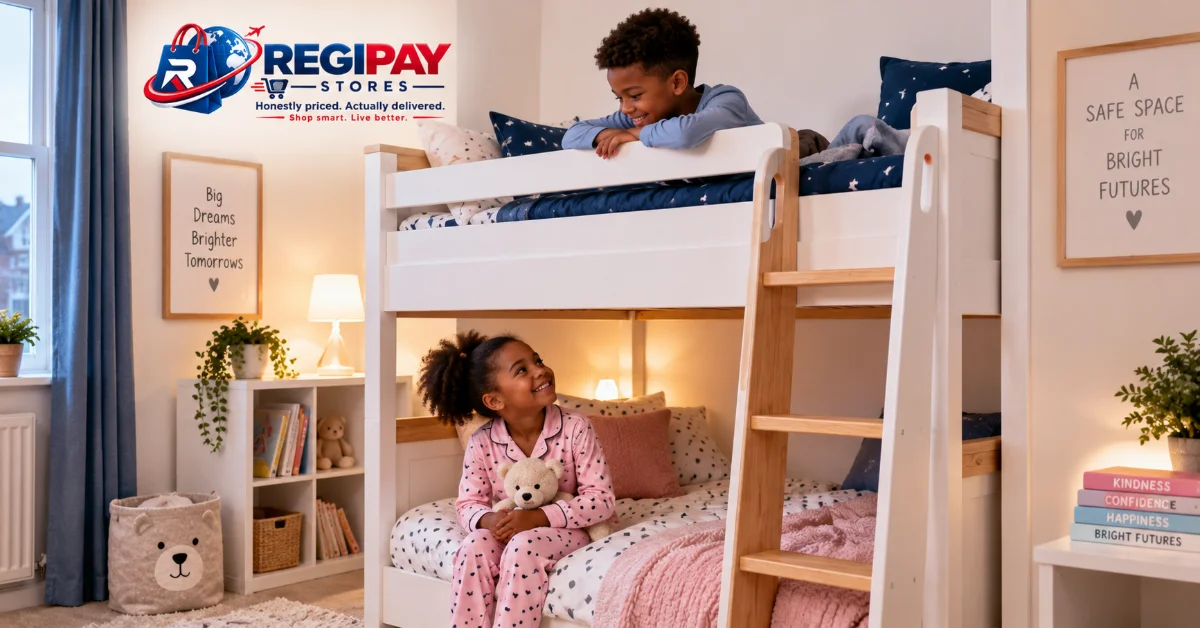
Bunk beds are safe when three things are true: the bed is made to BS EN 747, it has been assembled exactly as the instructions say and kept tight afterwards, and the child sleeping on top is old enough to be up there. Most problems in real homes come from the second and third of those, not the first. The bed you buy is rarely the weak point; how it is built, how deep the top mattress is and who sleeps on it usually are.
This guide covers the standard, the age question, guard rails and mattress depth, ladders against staircase bunks, the bolts that need re-checking, and when a bunk is the wrong answer.
Last reviewed September 2026. Prices, pack sizes and availability change, so confirm the current price on the product page before ordering.
What BS EN 747 covers, and what it does not
BS EN 747 is the British and European standard for bunk beds and high beds in domestic use. It runs to two parts, one setting out the safety requirements and one the test methods. It covers the strength of the bed, how the guard rails must be arranged, how the ladder is built and spaced, and which gaps a child's head, limbs or clothing must not be able to get into. That last part shapes the design most, because a gap that looks harmless to an adult can be the wrong size for a small head.
We are not going to quote millimetre figures for rail heights or gap sizes here. The numbers vary with the design and with the part being measured, and a half-remembered figure repeated from a blog is worse than none at all. The measurements for your bed are in the booklet that came with it, and that booklet is the authority. Not us.
A standard also cannot follow the bed home. It says nothing about whether the last four bolts were tightened, whether the mattress is too deep, or whether a four-year-old has been put up there because the room is small.
Look for a plain statement of conformity to BS EN 747 in the description or instructions, and ask the seller if a listing mentions none. That check sits alongside the general ones in our guide to telling whether a UK online shop is legitimate.
The age question: six is the guidance, readiness is the decision
Industry guidance in line with BS EN 747 is that the top bunk is for children aged six and over. Six is the figure the trade uses and a sensible place to start, because it roughly tracks the point at which a child can climb down a ladder in the dark, half asleep, without thinking.
Treat it as a floor rather than a pass mark. The real question is whether this child gets down safely when tired, and whether they will remember that the top bunk is not a climbing frame. Some seven-year-olds are ready. Some are not, and there is no prize for rushing it.
Sleepwalking and restless sleeping are a separate judgement, and age does not settle them. A child who sleepwalks, or who thrashes about and is sideways by morning, belongs on the bottom bunk however old they are, because the failure mode is a fall from height with no warning. If your child's sleep worries you, speak to your GP rather than designing around it with furniture.
Guard rails: what to look at
Guard rails are what make a top bunk a bed rather than a shelf, and they are most often compromised by accident.
Check that rails are fitted on both long sides, including the side against a wall. A wall is not a guard rail. Beds shift, walls are rarely flat, and the gap between a bed and a wall is its own hazard.
Look at how the rail meets the ends of the bed. On a well-made bunk it runs continuously into the headboard and footboard with no opening large enough to slip through, and the only gap is at the ladder. Follow the instructions on which piece goes where, because guard-rail fittings are often handed and can go in upside down without looking wrong.
When the build is finished, push a hand into the middle of each rail. It should feel solid rather than springy. If it moves in its fixings, a bolt is loose or a fitting is the wrong way round.
Mattress depth on the top bunk, the point most people miss
This one catches out careful parents, because the bed is fine, the assembly is fine, and the mistake arrives later in a separate delivery.
Guard-rail height is measured from the top surface of the mattress, not from the frame. Every centimetre of mattress raises the sleeping surface and cuts the effective rail height by the same amount. Put a deep mattress up there and you have quietly turned a compliant guard rail into a low ledge, without changing the bed at all.
Manufacturer guidance in line with BS EN 747 commonly caps top-bunk mattress depth at around 15 centimetres, but the figure that matters is the one in your instructions, and many bunks carry a maximum-fill line inside the frame. Measure the mattress you are buying rather than trusting the name, because "bunk mattress" is a marketing phrase and not a specification.
Two things get forgotten in the sums:
- A topper counts. A 15cm mattress with a 5cm memory foam topper is a 20cm mattress as far as the guard rail is concerned.
- So does a thick quilted protector, or a second mattress laid on top of a hard one.
Going too thin is not the answer either, so buy the deepest mattress your instructions allow, then stop. Keep the topper for the bottom bunk.
Ladders and staircase bunks compared honestly
A ladder is compact. It adds almost nothing to the footprint, costs less, and for a confident eight-year-old it is adequate. It is also steeper than a staircase and unforgiving of anything left on the rungs.
A staircase bunk is easier for younger and less confident children, because it is climbed facing forwards, and the treads usually double as drawers or cubes, giving back some of the storage a small bedroom lost to the second bed. The honest cost is floor space. A staircase adds considerably to the footprint, often its own length again along one side or across the end, which in a box room is the difference between a usable room and a corridor.
The other honest point is the trip hazard. Open treads, with a gap between each step rather than a solid riser, are easy to catch a foot in at night with a dressing gown trailing. Closed treads are kinder underfoot. Either way, keep them empty, because a staircase used as a shelf is worse than a ladder.
| Standard ladder bunk | Staircase bunk with storage | Two separate single beds | |
|---|---|---|---|
| Floor space used | Smallest, one single bed footprint | Considerably more, bed plus staircase along one side or the end | Largest, two single footprints plus access |
| Ease of access | Steep, climbed facing the bed, needs confidence | Easier, climbed facing forwards, usually a handrail | Easiest, no climbing at all |
| Storage gained | None from the bed itself | Drawers or cubes in the treads | Only with drawers or an ottoman base |
| Suitability by age | Six and up, given a confident child | Six and up, kinder to a less confident child | Any age, including under six |
| Main drawback | Unforgiving underfoot | Footprint, plus an open-tread trip hazard | Uses most of the room |
Our staircase bunk with a storage cube is £545.00 at the time of writing, on a longer lead time of 14 to 21 working days rather than the usual 3 to 7. Confirm both on the product page.
Assembly, and the bolts almost nobody re-checks
Read the instructions before you open the fittings bag, and build it with two people. A bunk bed is one of the few flat-pack items where a second pair of hands is not optional, because the frame is unstable until the top is bolted on.
The order matters more than on a wardrobe. Start every bolt loosely, get them all in, square the frame up, and only then go round and tighten. Tightening fully as you go pulls the frame out of square and leaves gaps in the wrong places. Use the tool supplied rather than a power driver, which strips fittings before you notice.
Then plan the re-checks, the part that gets forgotten:
- After the first week, since new joints do most of their settling early.
- Every three months after that. Put it in a calendar, because nobody remembers otherwise.
- Every time the bed is moved, even across the same room, because lifting or dragging a bunk racks the frame and loosens joints that felt solid.
- Straight away if the frame sways or creaks when a child climbs.
Keep the allen key and spare fittings bagged with the instructions, and keep the instructions for as long as you own the bed, since they are your reference for the mattress limit and the rail fitting. If parts arrive missing or damaged, ask the seller for the correct replacements, because bunk bed bolts are load-bearing and the length is not arbitrary.
What should never be attached to a bunk bed
Anything with a cord, a strap or a loop is a strangulation risk on a bunk bed, because the height means a child can be suspended by it. Nothing of that kind should hang from the posts, the guard rail or the ends of the top bunk. That rules out dressing gown ties, skipping ropes, bags with long straps, belts, lanyards, canopies with ties and string lights.
The corner posts are the usual offenders, because they sit at the height that makes them look like a hook. Put a proper hook on the back of the door, and glance at the posts now and then, since things reappear.
Keep the bed away from window blind cords, and check above it. There should be enough clearance for a child to sit up straight on the top mattress without touching the ceiling, and enough distance from a pendant light, a ceiling fan or a smoke alarm that none can be reached. Sloping ceilings and loft rooms need measuring before you order, not after.
House rules, and when a bunk bed is the wrong answer
Rules worth setting on day one
Say them once, clearly, then be boring about enforcing them. One person on the top bunk at a time. No jumping. Climb down facing the ladder. Nothing left on the rungs or treads. No climbing on the outside of the frame. A younger sibling does not go up, not even with an adult watching, and that rule only works if it is never bent.
A dim night light and a clear floor between bed and door do more for safety than most accessories, because many night-time falls happen on the way to the loo.
When a bunk bed is simply the wrong answer
- Low ceilings, or a sloping ceiling over the bed. If a child cannot sit up on the top bunk, it does not fit the room.
- A child under six with no older sibling to take the top bunk. A bunk with an empty shelf above it is an expensive single bed.
- A child who sleepwalks, where the top bunk is off the table and the second sleeping space is wasted.
- A room where the bed only fits under a window with looped blind cords.
- A household that will dismantle and rebuild the bed often. Every rebuild is another opportunity to get it wrong.
Where any of those apply, two separate beds are the better answer, and a single with storage underneath recovers some of the space. Our 3ft single wooden bed with a safety guardrail is £290.00 at the time of writing, and that guardrail is about a younger child rolling out at low level rather than anything to do with height.
Frequently asked questions
What age can a child sleep on the top bunk?
Guidance in line with BS EN 747 is six years and over for the top bunk. Six is a starting point rather than a guarantee, and how confidently your child climbs down when tired matters as much. Check your bed's instructions, as some set it higher.
Are bunk beds safe for a four-year-old?
A four-year-old can sleep safely on the bottom bunk but should not use the top one. The guidance of six and over exists because of the fall height and the ladder, and it is not worth bending for a few months.
How deep can a mattress be on a top bunk?
Most manufacturers cap it at around 15 centimetres, and the figure for your bed is in its instructions or marked inside the frame. Depth reduces the effective height of the guard rail, so an over-deep mattress makes a compliant bed less safe. Include any topper in the measurement.
Do you need a guard rail on both sides of the top bunk?
Yes. Fit rails on both long sides even when one is against a wall, because beds move, walls are not perfectly flat, and the gap between a bed and a wall is a hazard in itself.
How often should bunk bed bolts be tightened?
Check them a week after assembly, then every three months, and always after the bed is moved. Tighten by hand with the tool supplied, not a power driver.
Is a staircase bunk safer than a ladder bunk?
A staircase bunk is easier to climb, especially for younger or less confident children, which removes one common source of falls. It is not automatically safer, because open treads are a trip hazard, and it takes far more floor space than a ladder.
Choosing yours
If the room can take the footprint, a staircase bunk is the easier bed to live with. Ours is the staircase bunk with a storage cube at £545.00 at the time of writing, on a lead time of 14 to 21 working days. If it cannot, the 3ft single with a safety guardrail at £290.00 at the time of writing is the plainer answer, and the rest of the beds sit on the furniture category page.
Standard UK delivery is £7.99 and free on orders of £100 or more, most items estimated at 3 to 7 working days from dispatch. Measure the room and the ceiling before you order, and when the bed arrives, read the instructions that came with it rather than any article, this one included.