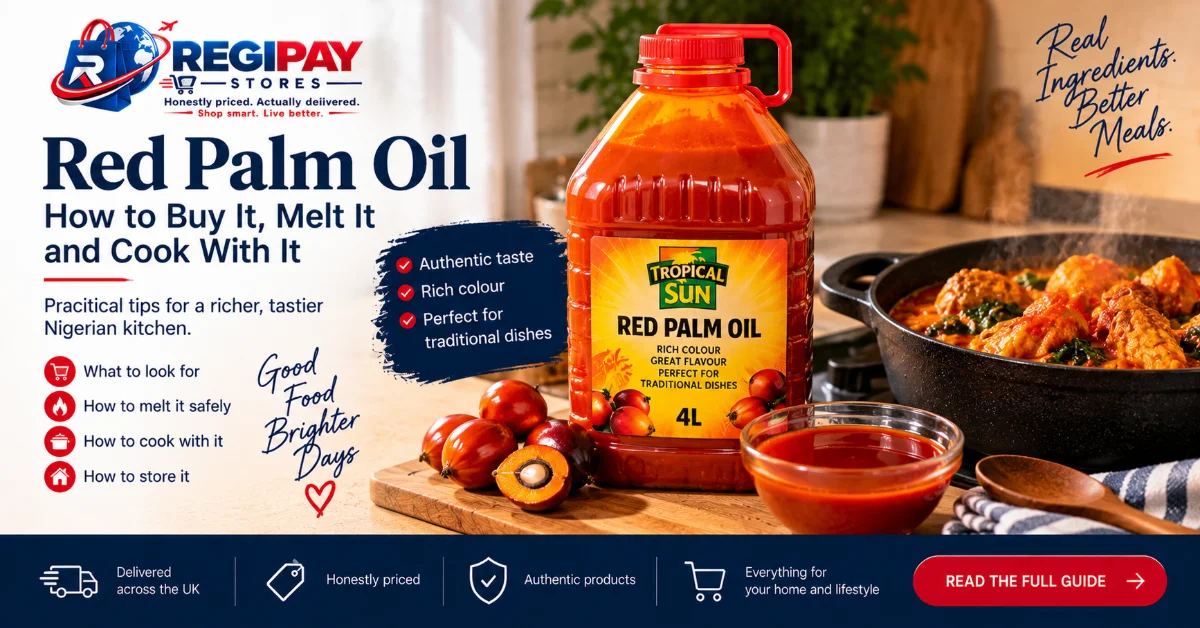
Red palm oil is pressed from the pulp of the oil palm fruit, not from the kernel inside it, and it is red because the fruit's carotenoid pigments survive when the oil is left unrefined. In a British kitchen it is often part solid, grainy or cloudy in the bottle, which is normal, harmless and reverses with gentle warmth. It is a base and finishing oil for particular dishes rather than a general frying oil, and treating it like sunflower oil wastes it.
This guide covers why it sets, how to melt it safely, how hot you can take it, how much to use, what to look for on the bottle and how to store it.
Last reviewed September 2026. Prices, pack sizes and availability change, so confirm the current price on the product page before ordering.
What red palm oil actually is
The oil palm fruit is a small plum-sized thing growing in dense bunches, with oily orange pulp around a hard nut, and a kernel inside that nut. Two entirely different oils come out of it, which is where the confusion starts.
Red palm oil comes from the pulp. Left unrefined, it keeps the colour, aroma and flavour of the fruit. It is semi-solid at British room temperature, deep orange to red-brown, and it smells sweetish and vegetal.
Red palm oil and palm kernel oil are not interchangeable
Palm kernel oil is pressed from the seed inside the nut. It is pale cream to dark brown depending on processing, it smells and tastes strongly and rather burnt-nutty, and it sets hard rather than grainy. It turns up in a few West African dishes and very widely in soap and cosmetics. Swapping one for the other does not give a slightly different result; it gives a different dish.
Refined palm oil is the same fruit with everything taken out
Refined, bleached and deodorised palm oil is pulp oil stripped of colour, aroma and flavour. It is off-white to pale yellow, neutral, has a high smoke point and is what most industrial baking and frying uses. Nothing wrong with it, but it will not colour or flavour a soup.
Why it is red
The colour comes from carotenoid pigments in the fruit pulp, and refining destroys them, which is why refined palm oil is pale.
That matters practically, because those pigments are heat-sensitive. Push the oil hard and the colour slides from bright orange to dull brown, taking the flavour with it. A dish that wants a bright finish gets its oil late and gently, not over a roaring hob.
Why it goes solid, grainy or cloudy in a British kitchen
This is the commonest worry about red palm oil, and nothing is wrong with it.
Palm oil is a mixture of fats with different melting points. Some fractions set at around normal room temperature, others stay liquid well below it, and a British kitchen sits below that setting point for much of the year. So the bottle separates: crystals form and stay suspended, and you get grains in clear oil, a pale set layer under a liquid one, or four litres gone the texture of orange butter.
None of that is spoilage, it does not mean the oil is old, and it is not a sign of adulteration. If anything it is mild evidence the oil is genuinely unrefined, because blended oils tend to stay liquid.
To tell normal setting from a real problem, smell it. Set palm oil smells exactly like liquid palm oil, sweetish and slightly earthy. Rancid oil smells sharp, stale and faintly like old paint. Trust the nose over the appearance.
The two safe ways to melt it
- Stand the sealed bottle in warm water. Fill the sink with hand-hot water, stand the closed bottle in it for ten to twenty minutes and turn it occasionally. Not boiling water, and cap on so nothing gets in. This is the method for a large bottle you do not want to decant.
- Warm what you need in the pan. Spoon it into a cold pan over the lowest hob setting for a minute or two until it runs clear and bright. Quicker, and what you will do most nights anyway.
Do not put a plastic bottle on the hob, in the oven or in boiling water, do not microwave a sealed bottle, and do not leave it on a hot appliance and forget it. Repeated melting and setting does no harm, though it leaves the colour looking uneven, so shake it once fluid.
Cooking with it, and the heat it will tolerate
Unrefined red palm oil has a lower smoke point than the refined kind, and it loses colour and aroma before it visibly smokes. Warm it until fully liquid and bright, then add your onions or your base. If it darkens from orange towards brown it has gone too far, and burnt palm oil is bitter all the way through the pot.
That one point explains most disappointing results. People treat it like vegetable oil, heat it until it shimmers, then wonder why the soup tastes acrid.
Bleaching palm oil, and when it is genuinely necessary
Some dishes want the red taken out, ofada stew being the obvious one. Bleaching means heating the oil until the pigments break down and it turns from red to a clear brownish-yellow, which also tames the raw palm flavour.
It is not difficult but it is genuinely unpleasant indoors. The oil foams, then smokes heavily for several minutes, and the smell gets into everything. Open the windows, run the extractor, keep a pan lid within reach, never add water to hot oil and do not walk away. Ten to twenty minutes on a medium-low heat, and the smoke alarm will have an opinion.
If a recipe does not specifically ask for bleached oil, do not do it. You are burning off the qualities you paid for.
What it suits and what it ruins
It suits the dishes built around it: banga soup and ofe akwu, egusi, ogbono, efo riro, okra soup, ewa agoyin and asaro. Our banga soup recipe shows how the oil works in practice, as a base and as a finish.
It ruins anything needing a neutral background or hard heat. Deep frying is wasteful and pushes it past its comfortable temperature, baking picks up the flavour in a way most cakes do not want, and delicate white fish, dressings and mayonnaise are simply bulldozed. Keep groundnut or vegetable oil for those jobs.
What it tastes like, and how much to use
The flavour is savoury and faintly sweet, a little earthy, slightly resinous, with a mouth-coating richness that does not fade during cooking. Nothing like olive oil, and it decides the character of whatever you put it in.
Quantity is where most British recipes go wrong, usually by being timid. Two tablespoons in a stew for four gives a hint of colour and almost no flavour, which is why so many attempts at Nigerian soups taste thin to people who grew up eating them. A traditional pot of egusi for six might use well over 100ml. The oil is an ingredient, not a lubricant.
Start at three or four tablespoons for four servings of a stew, or 100 to 150ml for a soup for four to six, then taste and adjust upwards next time. Red palm oil is a fat like any other cooking fat, and if you are watching what you eat for a medical reason, that is a conversation for your GP, pharmacist or a registered dietitian rather than a food blog.
Red palm oil against the other oils in your cupboard
| Red palm oil (unrefined) | Palm kernel oil | Groundnut oil | Vegetable oil | |
|---|---|---|---|---|
| Colour | Deep orange to red-brown | Cream to dark brown | Pale gold | Pale gold, near colourless |
| Flavour | Strong, savoury-sweet, earthy | Strong, nutty and burnt-edged | Mild, faintly nutty | Neutral |
| At UK room temperature | Semi-solid, often grainy | Sets hard | Liquid | Liquid |
| Behaviour under heat | Warm gently; colour and flavour go before it smokes | Tolerates more heat | High heat, suits deep frying | High heat, suits deep frying |
| Colours the dish | Yes, strongly | Slightly | No | No |
| Typical use | West African soups and stews | A few dishes, plus soap and cosmetics | Frying, chin chin, puff puff, akara | Everyday frying and roasting |
| Substitute for red palm oil | No | No, no colour or flavour | No, no colour or flavour |
Buying red palm oil in the UK
Bottle size and what it works out at
Palm oil is priced far better in volume, and the gap between a small bottle and a large one is not marginal. The honest counterweight is that four litres is a lot of oil, and it only makes sense if you cook these dishes often.
| Size | Price per litre | Roughly how long it lasts | Suits |
|---|---|---|---|
| 500ml to 1 litre | Highest | A few soups | Trying it, or cooking with it twice a year |
| 2 litres | Middling | Two to three months at a soup a week | Occasional cooks, small cupboards |
| 4 litres | £6.00 at the time of writing | About six months at 150ml a week | Weekly cooking and households |
Our Banga Red Palm Oil in 4 litres is £23.99 at the time of writing (October 2026), which is where that £6.00 a litre comes from, so check the product page for the current price. Standard UK delivery is £7.99 and free on orders of £100 or more.
What a good bottle looks and smells like
Fully melted and shaken, it should be a deep, slightly opaque orange-red, uniform through the bottle. It should smell sweetish, vegetal and faintly earthy, a bit like cooked carrot with something denser behind it, and taste clean with no sharpness.
The label should name the oil plainly, give an origin, carry a best-before date and a lot number, and show the name and address of the business responsible for the food. Prepacked food sold in Great Britain has to carry that address, and the Food Standards Agency publishes the rules. A bottle with no address and no batch code is one nobody has put their name to.
Signs something is not right
- It stays perfectly liquid and clear in a cold kitchen. Genuine unrefined palm oil sets or goes grainy when cold. Oil that never does may have been blended with a cheaper liquid oil.
- The colour is bright, flat and even, like dye. Real palm oil has depth and slight opacity. A thin, brilliant red that stains everything but tastes of nothing suggests colouring added to a neutral base.
- It smells of very little. A near-odourless red oil is usually refined oil with something added.
- It smells sharp, sour or like old paint. That is rancidity, and it means the oil is past it or has been stored badly.
None of these is proof, and you cannot test oil at home. Buying from a seller who names the brand, the origin and the pack size does more than any home check. Our post on how to tell if a UK online shop is legitimate covers the wider version of that question.
Storing it and how long it keeps
Keep it in a cool, dark cupboard, away from the hob, the window and anything that gives off heat. Light, heat and air turn oil rancid. Screw the cap down and wipe the neck, because oil left on the threads goes sticky and eventually off.
Do not refrigerate it. It sets rock hard, picks up condensation every time the door opens, and you gain nothing.
With a four litre container, decant a working amount into a smaller clean jar and keep the big one sealed, so you are not warming the whole thing every week. Go by the best-before date, and once opened use it within about a year. If it smells sharp or paint-like, throw it out; that judgement is a smell test, not a date.
Where palm oil sourcing stands
Palm oil production is linked to deforestation and habitat loss, mainly in South East Asia and increasingly in parts of West Africa, and anyone selling it should be willing to say so. Certification schemes exist, the best known being the Roundtable on Sustainable Palm Oil. We are not claiming any certification for the oil we sell, because we cannot evidence one, and we would rather say that than imply something we cannot stand behind. If sourcing matters to you, look for a certification mark on whichever brand you buy and make your own decision.
Frequently asked questions
Why has my red palm oil gone solid?
Because your kitchen is colder than the melting point of part of the oil, which is normal for unrefined red palm oil in Britain. It contains fats with different melting points, so it sets, goes grainy or turns cloudy at ordinary UK room temperature. Stand the sealed bottle in hand-hot water for ten to twenty minutes and it runs clear again.
Is red palm oil the same as palm kernel oil?
No. Red palm oil is pressed from the orange pulp of the palm fruit, while palm kernel oil comes from the seed inside the nut. They look, smell and behave differently, and substituting one for the other changes the dish rather than tweaking it.
Can you fry with red palm oil?
You can shallow fry gently, but deep frying is a poor use of it. Unrefined red palm oil loses colour and aroma before it visibly smokes, and hard heat leaves it bitter and brown. Use groundnut or vegetable oil instead.
How do you bleach palm oil?
Heat it in an open pan over a medium-low heat until it foams, smokes and turns from red to a clear brownish-yellow, usually ten to twenty minutes. Open the windows, run the extractor and do not leave the pan. Only do it when a recipe calls for bleached oil, such as ofada stew.
How long does red palm oil last once opened?
Go by the best-before date, and once opened aim to finish it within about a year if it is kept sealed in a cool, dark cupboard. Heat, light and air shorten that considerably. Smell it before use; rancid oil smells sharp and stale.
How much red palm oil should I use in a stew?
Three or four tablespoons for four servings of a stew is a reasonable start, and a traditional soup for four to six will use 100 to 150ml. Most British recipes use far too little and end up with colour but no flavour.
Choosing a bottle
If red palm oil goes into your cooking every week or two, buying it in volume is sensible, and if it will sit in the cupboard for two years it is not. We sell Banga Red Palm Oil in 4 litres at £23.99 at the time of writing (October 2026), alongside the rest of our African and Caribbean groceries, and the current price is on the product page.