A British winter dries hair and scalp through cold outdoor air that carries very little moisture and indoor heating that makes the air inside drier still, rather than through anything you are doing wrong. The fix is mostly about holding on to the water the hair has and cutting the friction it meets, not about buying more products. Afro-textured and coily hair feels it first and worst, for structural reasons.
This guide covers heating and humidity, washing, telling dry hair from a dry-feeling scalp, coily hair in particular, oils and butters, a routine table, and when none of this is the answer.
Last reviewed September 2026. Prices, pack sizes and availability change, so confirm the current price on the product page before ordering.
When this belongs with a GP or a pharmacist
Some of this is not a hair care question at all, and it is worth saying so first.
If a scalp is persistently itchy, flaking heavily, sore or bleeding, or if hair is coming away in patches, that is a matter for your GP or a pharmacist rather than for a routine or a shopping list. Nothing in this article is a substitute for that, and nothing sold as a cosmetic is either. A pharmacist can look at a scalp across the counter and say whether it needs more than a shop can offer.
The rest of this guide is about ordinary winter dryness: hair that feels rough and looks dull, and skin that feels tight after an evening in a heated room. That is cosmetic.
Why a British winter dries hair
Cold air holds very little water. Heat it indoors to twenty degrees and the amount of water in it does not change, but the air's capacity to hold water rises sharply, so the relative humidity falls. A heated living room in January is a dry place, and dry air draws moisture out of anything that has some.
Then there is the outdoor half of the day. Wind, a hat pulled on and off and a coat collar mean hair spends the winter being rubbed. Most winter damage is mechanical rather than chemical.
The honest version of the humidifier advice
Raising indoor humidity helps, and a cheap hygrometer tells you where you are before you spend anything. A humidifier is the direct route and also a faff, since they need refilling and cleaning often, and the method in our post on UK appliance running costs will tell you what one adds to a bill. Drying laundry on an airer in the room does less, and costs nothing.
If your windows run with condensation every morning, adding moisture is the wrong move and ventilation the right one, and our first UK flat checklist covers that job.
Hats, and where you sleep
A hat is not the problem. A wool or acrylic lining rubbing against hair for an hour a day is, and the cheapest fix is a satin or silk scarf underneath. Going out with soaking hair in freezing weather is worth stopping too, because hair is at its weakest when wet.
The pillow is where hair spends about a third of its life. Turn the bedroom radiator down rather than up, and change what the hair lies on: long hair loosely gathered on top of the head meets far less pillow than hair spread out underneath you.
Dry scalp or dry hair, and why the difference matters
These are two different things, and treating the wrong one is how a whole winter goes by with nothing improving.
Dry hair is a fibre problem: rough, dull, tangling, no longer holding a style, and always worst at the ends, which are the oldest part of the strand. A dry-feeling scalp is a skin problem: tightness at the roots, most noticeable after washing. You can have a tight-feeling scalp and perfectly soft lengths, or oily roots and parched ends on the same head.
So conditioner and oil on the lengths do nothing for how a scalp feels, and heavy product at the roots does nothing for rough ends. Decide which end of the strand you are unhappy with before changing anything, and if the scalp has gone past feeling tight, the section above applies instead.
Washing in winter: how often, and how hot
Frequency depends on the hair rather than the season, though winter pushes most people towards less. Straight and wavy hair carries the scalp's oil down the strand efficiently and usually wants washing every two to four days. Coily hair does better at once a week to once a fortnight. Daily shampooing is the commonest reason hair feels stripped in January.
Water temperature is the part almost everyone gets wrong, because the wrong answer feels lovely. A very hot shower removes the surface lipids on the hair and the natural oil on the scalp far more thoroughly than warm water does, and hair that comes out squeaky feels rougher once it dries. Wash comfortably warm rather than hot, with a cooler final rinse if you can face it. Shampoo belongs on the scalp, conditioner on the mid-lengths and ends.
Afro-textured and coily hair in a cold country
Coily hair is the driest-feeling hair type in a British winter, and the reason is structural rather than behavioural.
Why the natural oil never reaches the ends
A straight strand is close to a smooth cylinder, so the scalp's oil travels down it easily, which is why straight hair goes greasy at the roots while its ends stay reasonably lubricated.
A coiled strand twists along its length, is elliptical rather than round in cross-section, and its cuticle scales lift at every bend. Oil moving down it has to negotiate every turn and mostly does not get far, so the ends of coily hair are the least lubricated part of the head that needs it most. That is why coily hair can feel dry while the scalp feels fine, and why the work is putting water in and keeping it there.
LOC and LCO, explained plainly
These are orders for putting three things on damp hair:
- L, liquid. Water or a water-based leave-in, and the only step that adds moisture. Hair should be damp, not dripping and not dry.
- O, oil. A layer that slows water leaving. It does not moisturise; it sits on the surface and makes evaporation harder.
- C, cream. A thicker emulsion of water, oils and emollients that adds slip, softens the feel of the hair and carries more weight than oil.
LOC is liquid, oil, cream. LCO is liquid, cream, oil, so the oil ends up outermost.
Neither order is correct in general. LCO seals harder and suits hair that loses moisture quickly, LOC feels lighter. Do one for two or three weeks, then the other, keeping the products the same, and judge by how the hair feels on day three.
Protective styling and the tension point
Protective styles work because they tuck the ends away and cut daily handling right down. Two caveats.
The first is tension. A style that pulls at the hairline is doing constant mechanical work at the most fragile point, and looking neat does not make it harmless. If it stings, gives you a headache the first evening, or raises small bumps along the parting, it is too tight and needs loosening or taking out.
The second is time. Left in too long a style protects nothing: hair still sheds inside it, tangles with what is attached, and the take-down becomes the most damaging hour of the month.
Satin, silk, and the friction physics
Cotton is spun from short fibres and its woven surface is rough at the scale a hair cares about. It is also absorbent by design, which is why we make towels from it. Hair moving across cotton catches on it, and the cotton pulls water and product off as it goes.
Satin is a weave rather than a fibre. Most of the yarn floats across the surface, giving a smooth face with few points to snag on. Silk is a fibre, and silk satin does the job beautifully and expensively; polyester satin does nearly all the same friction work for far less. A bonnet does more again, because it holds the hair still, though the honest downside is that bonnets come off in the night. If you only do one, do the pillowcase.
What oils and butters are actually doing
Oil does not moisturise, water does, and oil seals. Every product that genuinely adds moisture has water at or near the top of its ingredients list, which is why leave-ins and water sprays are the moisturising step.
On the hair shaft, most oils sit on the surface. They lie the cuticle flatter, add shine and slip, cut combing friction and slow the rate at which water leaves. Castor oil seals hard and feels tacky; grapeseed and jojoba sit lightly.
On the scalp, oil does less than the internet suggests. It sits on the skin's surface and can make a tight-feeling scalp more comfortable, but it is not feeding anything, and nightly layering under a bonnet leaves a residue to wash off. Once or twice a week is plenty.
Butters, mainly shea and mango, are the heavy end of the same idea, solid at room temperature and leaving a much more substantial film. Sensible as an outermost layer on coily hair in January, greasy within hours on fine hair.
Sealing works in both directions. Put oil or butter on hair that is dry rather than damp and you seal the dryness in. Damp first, always.
A winter routine for two hair types
Treat this as a starting point rather than a rule.
| Step | Straight, wavy or loose curls | Afro-textured or coily |
|---|---|---|
| Wash frequency | Every 2 to 4 days | Every 7 to 14 days |
| Shampooing | Warm water, scalp only, one wash | Warm water, gentler shampoo, hair sectioned first |
| Conditioning | Mid-lengths and ends, 2 to 3 minutes, cool rinse | Deep conditioner 15 to 30 minutes, detangle with a wide-tooth comb while it is in |
| Drying | Blot with a T-shirt or microfibre towel, air dry or low heat | Blot rather than rub, air dry or hooded dryer on low |
| Sealing on wash day | Light leave-in on damp ends, oil if the hair takes it | Full LOC or LCO on soaking-damp sections, ends first |
| Mid-week | Water-based leave-in on rough ends, no rewash | Water or leave-in spray on dry sections, reseal the ends, restyle once or twice |
| Nightly | Loosely gathered up, soft tie, satin pillowcase | Bonnet or scarf plus satin pillowcase, twists or plaits rather than loose hair |
If a step there makes your hair worse, drop it. Fine hair will not tolerate the sealing in the right-hand column, and coily hair will not last a fortnight on the left.
What to stop doing, and what to stop worrying about
Things worth stopping
- Washing every day. The fastest route to a stripped-feeling scalp and rough ends in winter.
- Dry heat. Straighteners, tongs and a hot dryer held close drive water out of the fibre, and an already dry room compounds it.
- Tight styles worn continuously. Back-to-back styles with no break keep constant tension on the hairline for months.
- Alcohol-heavy sprays used daily. A refresher with a volatile alcohol high on its list evaporates fast and takes water with it.
- Brushing dry coily hair from the roots down. Detangle damp, with conditioner in, from the ends upwards.
Reading an ingredients list without becoming obsessive
Ingredients are listed in descending order of weight down to about one per cent, after which order means very little. Water is first in nearly every conditioner, which is the point above about what moisture is.
The useful distinction is between two sorts of alcohol. Cetyl, cetearyl and stearyl alcohol are waxy fatty alcohols that give products body and leave hair feeling softer. Alcohol denat., SD alcohol and isopropyl alcohol evaporate quickly and leave hair feeling drier when high on the list.
Silicones and sulfates are not villains either. Dimethicone gives slip and shine, and some silicones need a proper wash to shift, which is a build-up question rather than a moral one. Washing habits, water temperature and friction account for most of what changes over a winter.
Frequently asked questions
Why is my scalp so dry in winter?
Because heated indoor air is much drier than the same air outdoors, and dry air pulls moisture from skin. Hot showers and frequent washing then remove the surface oil that would otherwise slow the loss.
How often should I wash my hair in winter?
Straight and wavy hair usually suits every two to four days, and afro-textured or coily hair every seven to fourteen. Winter pushes both intervals slightly longer. Daily washing is the habit most likely to leave hair feeling stripped.
Does hot water dry out your hair?
Very hot water removes surface lipids from the hair and natural oil from the scalp more thoroughly than warm water, so hair feels rougher once it dries. The squeaky feeling after a hot shower is that removal rather than cleanliness, and comfortably warm with a cooler rinse is the sensible compromise.
What is the difference between a dry scalp and dry hair?
Dry hair is a fibre issue, worst at the ends, showing as roughness, dullness and tangling. A dry-feeling scalp is a skin issue at the roots, showing as tightness. You can have either without the other, which is why conditioner on the lengths changes nothing about a scalp.
Do satin bonnets and pillowcases actually work?
Yes, for friction. A satin weave is smooth, so hair slides across it instead of catching, and unlike cotton it does not absorb water and product off the hair overnight. Polyester satin does most of what silk does for far less.
Getting through the winter
Almost everything that works this winter is free: cooler water, fewer washes, less friction against cotton, and sealing hair while it is damp.
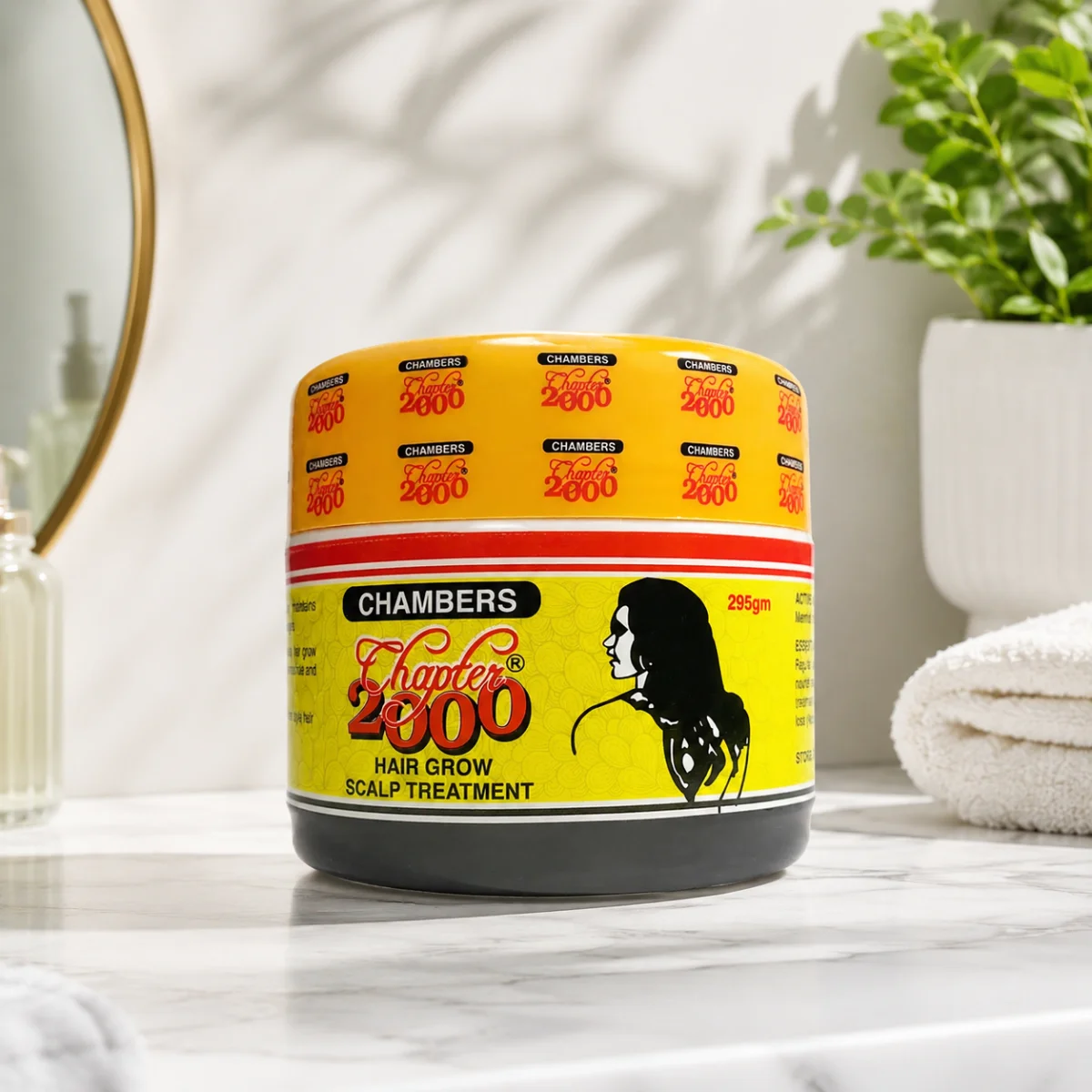
If you want one conditioning product for the hair and scalp to work into a weekly routine, we stock the Chambers Chapter 2000 Hair & Scalp Treatment 295g at £13.44 at the time of writing, alongside the rest of our beauty range. It is a cosmetic product and should be used as directed on its own label, and the current price is on the product page.
One last time, because it matters most. If a scalp is persistently itchy, sore, bleeding or flaking heavily, or hair is coming away in patches, none of the above is the answer. Speak to a pharmacist or your GP.